
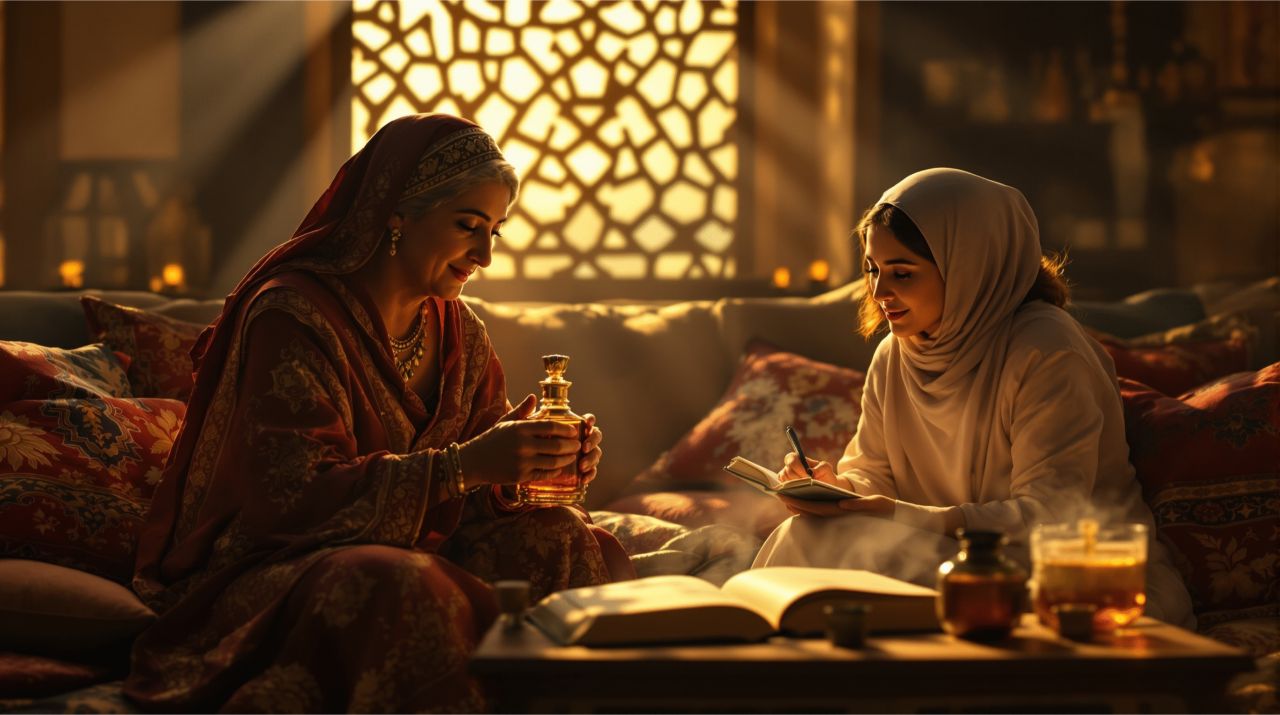
In Arab culture, perfume isn’t just about smelling good. It’s about carrying stories—stories of love, survival, faith, memory, and identity.
Today, I’m going to share sixteen real cultural stories involving Arabian perfume. Some are ancient legends passed down for thousands of years. Others happened just last week. Some will make you smile. Others might make you cry. But all of them reveal why perfume matters so deeply in Arabian culture.
These aren’t just perfume stories. They’re human stories. And by the end, you might discover that you have a perfume story of your own waiting to be told.
- Ancient Stories: Where It All Began
- Prophet Muhammad’s Perfume Stories
- Family & Generational Stories
- Love & Romance Stories
- War & Resilience Stories
- Migration & Diaspora Stories
- Modern Stories: Tradition Meets Today
- Healing & Transformation Stories
- The Stories Continue: How You Can Add Yours
- Conclusion: Stories as Living Heritage
Ancient Stories: Where It All Began
Let’s start at the very beginning—because the story of Arabian perfume begins with an incredible woman who lived over 3,000 years ago.
Story #1: Tapputi, the World’s First Perfumer (1200 BCE, Mesopotamia)
Picture this: Ancient Mesopotamia, in what is now Iraq. The year is approximately 1200 BCE. In a time when most records focused on kings and wars, one clay tablet tells a different story—the story of a woman named Tapputi.
Tapputi wasn’t royalty. She wasn’t a warrior. She was a chemist and perfumer, and she did something extraordinary: she wrote down her perfume formula. This makes her not only the world’s first recorded perfumer but also one of the earliest documented female scientists in human history!
The clay tablet—discovered by archaeologists thousands of years later—describes her process in detail. Tapputi took flowers, oils, and aromatic materials like myrrh, cyperus (a reed-like plant), and balsam. She distilled them, mixed them, and filtered them repeatedly until she created complex, long-lasting fragrances.
But here’s what makes her story so powerful: In a world that often forgot women’s contributions, Tapputi’s name survived. Her recipe survived. Why? Because she bothered to write it down. She knew her knowledge was worth preserving.
The lesson? Every perfumer working today—whether in a Dubai souk, a Paris laboratory, or a home kitchen—traces their art back to Tapputi. She’s the grandmother of everyone who has ever mixed a scent. When you smell Arabian perfume, you’re experiencing a tradition that a Mesopotamian woman started 3,200 years ago.
Can you imagine how many hands have passed down her techniques? How many generations learned from generations who learned from generations… all the way back to Tapputi? That’s the power of preserved knowledge. That’s why stories matter.
Story #2: The Queen of Sheba’s Perfume Gift (Biblical Era, Yemen/Ethiopia)
Now let’s jump forward a few hundred years to another powerful woman with a perfume story: the legendary Queen of Sheba.
You might know the basic tale from religious texts—the queen who traveled to Jerusalem to test King Solomon’s famous wisdom. But what you might not know is the role perfume played in this encounter.
According to ancient accounts, the Queen of Sheba didn’t arrive empty-handed. She brought gifts that would take Solomon’s breath away: camel caravans loaded with gold, precious stones, and most importantly—frankincense and myrrh from her kingdom (modern-day Yemen and parts of Ethiopia).
These weren’t just any gifts. Frankincense and myrrh were “liquid gold”—more valuable than actual gold in many ancient markets! These resins, harvested from special trees, produced fragrances so intoxicating, so complex, that they were reserved for kings, gods, and the most sacred ceremonies.
But why perfume as a diplomatic gift?
Because in ancient Middle Eastern culture, perfume communicated things words couldn’t:
- Wealth: “My kingdom is so rich, I can afford to give away treasures”
- Sophistication: “My people understand beauty, art, and refinement”
- Intimacy: “This scent will remain with you, reminding you of me”
Some scholars believe the Queen of Sheba wasn’t just demonstrating wisdom to Solomon—she was also demonstrating seduction. After all, what’s more seductive than a woman who literally leaves her scent lingering in your palace?
The legacy of this story? For thousands of years afterward, Arabian perfume became synonymous with diplomacy, power, and romance. When you wanted to impress someone important, you brought perfume. When you wanted someone to remember you, you wore unforgettable scent.
Even today, Yemeni frankincense is considered among the finest in the world. The Queen of Sheba’s perfume gift is still being given, thousands of years later. That’s how stories shape culture—they create traditions that outlive empires.
Prophet Muhammad’s Perfume Stories
Now we move into stories that shaped not just Arabian perfume culture, but Islamic spiritual practice worldwide. These stories involve Prophet Muhammad (peace be upon him), whose love of fragrance became part of religious tradition followed by nearly 2 billion Muslims today.
Story #3: The Prophet Who Never Refused Perfume
Here’s what we know from historical accounts:
Ayesha, one of the Prophet Muhammad’s wives, reported: “The Oud was the best type of perfume the Prophet loved.”
Another companion, Anas, said: “The Prophet never declined to have a touch of perfume offered to him.”
And Ayesha also noted: “The Prophet disliked to go out to meet his companions without wearing some perfume. He would have a touch of perfume toward the end of the night.”
Let’s think about what these accounts tell us.
First, the Prophet had specific preferences—he loved oud above all other scents. This wasn’t just casual appreciation; it was genuine love for a particular fragrance. He experienced beauty through scent the way others experience it through art or music.
Second, he never refused perfume when offered. In Arabian culture, this became a powerful teaching: refusing perfume was like refusing connection, refusing kindness, refusing beauty itself. To accept perfume was to accept the gift of human warmth.
Third, he made perfume part of his daily practice—especially before meeting people and before sleep. This showed that perfume wasn’t vanity; it was respect. You perfumed yourself for others, to make being near you a pleasant experience.
How did these stories change Arabian culture?
For the last 1,400 years, millions of Muslim men have followed these teachings. Every Friday, before communal prayer, they apply perfume. Not because it’s required, but because they want to follow the Prophet’s example. They want to walk in his footsteps—literally, by smelling like he might have smelled.
One Saudi man I know explained it to me: “When I put on oud before Friday prayer, I feel connected to the Prophet across fourteen centuries. The same scent he loved, I’m wearing. That connection is… it’s beyond words.”
The lesson from these stories? Small, beautiful practices—like wearing perfume—can create bridges across time. When you make beauty a habit, you make tradition alive.
Story #4: The Night Perfume Ritual
Here’s a more intimate story from the Prophet’s life that reveals something beautiful about Arabian perfume culture.
Ayesha reported that the Prophet Muhammad would apply perfume “toward the end of the night”—meaning before sleep.
Why would someone perfume themselves before bed? Nobody else would smell it, right?
But that’s exactly the point. This wasn’t about impressing others. This was about honoring yourself and creating sacred space.
In Islamic spiritual practice, nighttime is considered special. It’s when the world quiets down, when you’re alone with your thoughts and your Creator. Applying perfume before sleep was a way of saying: “Even in private moments, I choose beauty. Even when alone, I treat myself with respect.”
This practice created a tradition that continues today:
Many Muslim families—not just Arabs—keep a special “night perfume” near their beds. Parents teach their children: “Before you sleep, put on something that smells beautiful. Start and end your day with something good.”
A young Egyptian woman told me her story: “My grandmother always wore jasmine at night. Always. When I was little and couldn’t sleep, I’d crawl into bed with her, and that jasmine smell meant safety. Even now, if I’m stressed, I put on jasmine. Instantly, I’m five years old again, safe with Teta (grandmother).”
The lesson? The Prophet’s simple practice—perfuming before sleep—created a ritual that has comforted countless people across centuries. Small acts of beauty become acts of love. That jasmine didn’t just smell good; it carried peace, safety, and connection across generations.
Family & Generational Stories
Now let’s move to more recent stories—stories of real families passing down perfume traditions from grandmother to mother to daughter, from grandfather to father to son. These stories show how heritage stays alive through daily practice.
Story #5: Mona Haddad’s Three Days and Nights (United Arab Emirates)
This story starts with a disaster.
Mona Haddad was seventeen years old, living in the United Arab Emirates, and she had big plans. She was competing in the UAE Young Entrepreneurship Competition—a massive event where young people could win money and recognition for their business ideas.
Mona’s plan? Sell fashion accessories. She had it all figured out. Until the shipment didn’t arrive.
Days before the competition, her accessories were stuck in customs. No products meant no business. No business meant embarrassment in front of the whole country. She panicked.
In desperation, she called her mother, who was studying in Germany at the time. Through tears, Mona explained the disaster. Her mother was quiet for a moment, then said something that changed Mona’s life:
“Make bakhoor instead. Just like how your ancestors did it.”
Bakhoor. Perfumed wood chips and incense. A tradition Mona had grown up around but never really paid attention to. She had watched her grandmother make it, but never bothered to learn.
“But I don’t know how!” Mona protested.
“I’ll teach you,” her mother said. “Over the phone. Right now. Get a pen.”
For three days and three nights, Mona barely slept. Her mother guided her through the process via phone calls: which wood to use, how to grind the ingredients, what oils to mix, how long to let it age. Mona’s hands learned what her brain had ignored for years.
When competition day arrived, Mona set up her table with handmade bakhoor. Other students had professional displays and slick presentations. Mona had incense she’d made in her kitchen. She sold every single piece.
By the end of the competition, she had earned $2,000—more than most other competitors.
But here’s the real treasure: Mona discovered something more valuable than money. She discovered that her heritage could save her when modern plans failed. Those “old-fashioned” traditions her grandmother practiced? They weren’t outdated. They were survival skills disguised as culture.
Today, Mona Haddad is a celebrated perfumer and educator. She teaches workshops at events like the Smithsonian Folklife Festival in Washington DC, showing people from around the world how to make traditional Arabian perfumes.
And she has advice for anyone learning perfume-making: “Always make perfume with a person in mind. To mix a really good fragrance, think of someone you really love.”
The lesson from Mona’s story? When you feel lost or when modern life fails you, look back at what your ancestors knew. Heritage isn’t just history—it’s a toolbox for survival. Those three days changed Mona from someone who ignored tradition to someone who preserves it for the world.
Story #6: The Grandmother’s Buried Bakhoor (Saudi Arabia)
Speaking of Mona’s grandmother—let me tell you about one of her techniques that sounds absolutely crazy until you understand the genius behind it.
Mona’s grandmother was from Saudi Arabia, and she practiced a bakhoor-making method that combined Saudi and Emirati traditions. The Saudi version was special: she would cook the incense mixture with sugar until it became hard as a rock, then bury it in the sand like you’d bury wine in a cellar.
“Why bury perfectly good bakhoor in the desert?” you might ask.
Temperature control.
In Saudi Arabia’s intense heat, normal storage would cause the bakhoor’s fragrance to evaporate too quickly. But buried underground, where the sand stays cool, the bakhoor aged slowly, developing deeper, more complex scents over months or even years.
Mona learned both her grandmother’s Saudi technique (hard, buried bakhoor) and her own Emirati tradition (softer bakhoor that doesn’t need burying). She became a walking bridge between two regional traditions.
Now here’s the beautiful part: Mona doesn’t pick one over the other. She teaches both. She tells students: “My grandmother taught me that there’s no single ‘right way.’ Different families, different regions, different stories—all valid. All beautiful.”
This is how cultural diversity survives: When one person learns multiple traditions and refuses to let any of them disappear.
Think about how much knowledge Mona’s grandmother had in her head—techniques passed down for generations, never written in books. If Mona hadn’t taken those three desperate days to learn, all of that would have been buried with her grandmother, far deeper than any bakhoor in the sand.
The lesson? Cultural knowledge is fragile. It lives in grandmothers’ memories, in mothers’ hands, in whispered phone conversations across continents. If you don’t learn it, it disappears. But if you do learn it? You become the keeper of centuries.
Love & Romance Stories
Now let’s talk about something everyone understands: love. In Arabian culture, perfume and romance are so intertwined that there’s actually a saying: “Love at first sniff.” Let me show you what that means.
Story #7: “Love at First Sniff” – Emirati Courtship
In traditional Emirati culture, courtship worked differently than you might expect.
Young men and women didn’t date casually like in Western cultures. But that doesn’t mean there was no flirting! In fact, the flirting was quite sophisticated—and perfume played a starring role.
Here’s how it worked: A young man might see a young woman who caught his interest. If he wanted to express his admiration, he would walk past her and recite poetry—romantic verses about beauty, longing, and desire. This was socially acceptable and quite common.
But if he wanted to really make an impression? He would compliment her scent.
Mona Haddad explained it perfectly: “Guys here tend to flirt in an obvious way. When they think you’re charming, they will pass by you while reciting a poem. But if he compliments something about your smell, the girls would be extra flattered.”
Why was scent more intimate than appearance?
Think about it: Anyone can see a beautiful face or nice clothes. But to notice someone’s perfume, you have to be close enough to breathe them in. You have to want to be near them. A scent compliment wasn’t just “you look nice”—it was “I want to be close enough to know how you smell.”
Plus, in a culture where women often covered their faces and bodies, perfume became a way to express personality and beauty that wasn’t visible. Your scent was your signature. If someone remembered your perfume, they remembered you.
Modern version: This tradition continues today among young Emiratis! A friend told me about her friend’s recent “perfume proposal”:
A young man had been interested in a woman for months. He finally worked up the courage to express his feelings. Instead of just saying “I like you,” he gave her a custom-made perfume he’d commissioned from a traditional perfumer. The scent included notes that represented things about her: jasmine for her laughter (light and sweet), oud for her strength (deep and lasting), and rose for her kindness (classic and beautiful).
She said yes. Not just because of the perfume, but because of what the perfume showed: that he had paid attention, that he understood her, that he wanted to create something just for her.
The lesson? In some cultures, scent is more personal than sight. To know someone’s perfume is to know something intimate about them. That’s why Arabian perfume isn’t just about smelling good—it’s about being memorable, about creating emotional connections that last long after you’ve left the room.
Story #8: The Refugee’s Wedding Perfume (Syrian Story)
Now let me tell you a love story that will break your heart and put it back together again.
Her name was Layla (changed for privacy), and she was a young Syrian woman who fled the war to Lebanon. She left in the middle of the night with her family, carrying only what they could fit in two suitcases.
Everything was left behind: her home, her childhood bedroom, her books, photos, most of her clothes, jewelry her mother had given her. Everything.
Except one small bottle.
It was her grandmother’s wedding perfume—a family recipe that had been passed down for over 100 years. Every bride in Layla’s family for five generations had worn this exact scent on her wedding day. The formula was written in her great-great-grandmother’s handwriting in an old notebook, and Layla’s grandmother had made one last batch before she died.
This wasn’t just perfume. This was liquid family history.
Two years after fleeing Syria, Layla met someone in the refugee camp. They fell in love. He proposed. But Layla felt lost: “How can I have a proper wedding in a refugee camp? Without my family’s traditions? Without being in my homeland?”
Then she remembered the small bottle. She still had her grandmother’s wedding perfume.
On her wedding day—in a simple ceremony in a tent, surrounded by other refugees—Layla wore her grandmother’s perfume. And in that moment, something magical happened: She smelled like home.
She smelled like her grandmother’s hands making that perfume. Like her mother’s wedding day. Like her country before war. Like every bride in her family for 100 years.
She wasn’t in Syria. But Syria was on her skin.
Layla told me this story herself: “When I put on that perfume, I wasn’t a refugee anymore. I was a bride in my family’s tradition. My grandmother was with me. My mother was with me. All the women in my family who had worn that scent before me—they were all there.”
Here’s where the story gets even more beautiful: Layla didn’t just keep this perfume for herself. She started teaching other Syrian refugee women how to make traditional perfumes. It gave them:
- Income (they could sell perfumes)
- Purpose (they were preserving Syrian culture)
- Connection (they were doing something their grandmothers did)
- Hope (they were creating something beautiful despite hardship)
The lesson from Layla’s story? Sometimes the smallest things carry the biggest stories. That perfume bottle wasn’t just fragrance—it was home in her pocket, history in her suitcase, hope in liquid form. When everything else is taken from you, the things you carry become sacred. And sometimes, those sacred things can rebuild lives.
War & Resilience Stories
Speaking of hardship—let me share stories about people who held onto perfume traditions even when the world around them was falling apart. These stories show how heritage becomes strength during the darkest times.
Story #9: The Damascus Perfumer Who Never Stopped (Syria)
In the heart of Damascus, there was a perfume workshop that had operated continuously for 300 years. Three centuries. Fourteen generations. Through Ottoman Empire, French colonial rule, independence, and every political change in between—this family made perfume.
Then came the Syrian conflict.
The workshop was in a historic neighborhood that became a battleground. Bombing destroyed half the building. The roof caved in. Windows shattered. Equipment was damaged. Most shops in the area closed. People fled.
But the perfumer—an older man I’ll call Ahmad—refused to leave.
Every day, in the partially-destroyed workshop, Ahmad continued making rose water. Sometimes with electricity, sometimes without. Sometimes with running water, sometimes carrying water in buckets from blocks away. He never stopped.
When journalists asked him why, his answer was simple and powerful:
“My family has made rose water for 300 years. Bombs won’t stop us. This is who we are. If I stop, they win. If I keep making perfume, my family’s story continues.”
Think about what that means: Making perfume wasn’t just his job. It was his resistance. It was his way of saying: “You can destroy buildings, but you can’t destroy culture. You can take away everything else, but you can’t take away who I am.”
Other artisans in Damascus saw what Ahmad did. Some of them returned to their workshops. A carpet weaver started weaving again. A calligrapher started writing again. A baker started baking again.
Ahmad’s perfume inspired a movement: If this old man could keep tradition alive in ruins, they could too.
The lesson? Heritage isn’t just about happy times and celebrations. Sometimes, heritage is what keeps you human when everything around you is inhuman. When you keep making the thing your ancestors made, you’re saying: “I’m still here. We’re still here. You can’t erase us.”
Ahmad’s rose water—made in a bombed-out workshop—smelled the same as his great-great-grandfather’s rose water. War couldn’t change the scent. And that’s why it mattered.
Story #10: The Scent That Meant Safety (Palestinian Story)
This story is quieter but no less powerful. It’s about how perfume can become an anchor when everything else is unstable.
A Palestinian family was displaced multiple times over several decades—from one place to another, to another, to another. Each move meant new homes, new schools, new neighbors, new everything. For the children, life felt like constant motion, constant change.
But one thing never changed: Their mother’s perfume.
No matter where they lived, no matter how little money they had, no matter what crisis they faced, their mother always wore the same attar. It was a simple blend—mostly amber with hints of musk—but to her children, that scent meant one thing:
“If I smell Mama’s perfume, I’m safe.”
Even in chaos, even when everything around them was uncertain, that familiar scent told them: “Mama is here. We’re together. We’re going to be okay.”
One of those children—now an adult—told me: “I could be blindfolded in a crowd of a thousand people, and if my mother walked by, I would know. That perfume… it’s not just a smell. It’s every time she held me when I was scared. It’s every meal she made with whatever we had. It’s every time she said ‘we’ll be fine’ when I didn’t believe her.”
Now, as an adult, this woman wears the same perfume for her own children.
She told them: “This is what safety smells like. No matter what happens, when you smell this, you know you have a home. Even if that home is just me.”
The psychological power of this is profound. Research shows that smell is the sense most closely linked to memory and emotion. By keeping one consistent scent through years of instability, this mother created a sensory anchor for her children’s entire childhood.
The lesson? Perfume can be more than beauty—it can be consistency, security, and love made tangible. When you wear the same scent for years, especially during difficult times, you’re not just wearing perfume. You’re creating a promise: “I’m still me. We’re still us. This is constant.”
Migration & Diaspora Stories
Now let’s talk about people who carried Arabian perfume traditions across oceans to new countries. These stories show how heritage adapts without disappearing.
Story #11: The Lebanese Grandmother in Michigan
In 1972, a Lebanese woman named Samira (real name changed) immigrated to Detroit, Michigan with her husband and three young children. Like most immigrants, she could only bring what fit in suitcases.
What did she pack?
Clothes (minimal). A few family photos. Important documents. And—taking up precious space—all the ingredients to make traditional Lebanese rose water: dried rose petals, distillation equipment parts, and a handwritten recipe from her mother.
Her husband thought she was crazy: “We’re going to America! You can buy perfume there!”
Samira’s response: “Not this perfume. Not our perfume.”
In Detroit, Samira set up her makeshift distillation in the basement of their small apartment. Every few weeks, the entire building would smell like roses. Her neighbors complained. They called it “that weird smell.” They asked the landlord to make her stop.
Her own children were embarrassed. “Mom, why does our house have to smell different from everyone else’s?” they’d complain. They wanted to be normal Americans, not the weird family with the strange-smelling house.
But Samira persisted. Every week, she made her rose water. She wore it. She gave bottles to other Lebanese families in Detroit. She taught the few people who asked. She refused to let it die.
Fast forward thirty years:
Samira’s grandchildren—born in America, never lived in Lebanon—suddenly became interested in “that weird smell” from childhood. One of them, now in her twenties, asked: “Teta (grandmother), do you still make that perfume?”
“Of course,” Samira said. “Every week since 1972.”
The granddaughter smelled it and started crying. She couldn’t explain why. But something in that scent triggered every memory of her grandmother’s house, every summer visiting relatives, every story Samira had told about Lebanon.
Now all three grandchildren are learning to make Samira’s rose water. The recipe that their parents rejected, they’re desperately trying to preserve. They film Samira teaching them. They write down every step. They practice until they get it right.
What changed? Why did the third generation embrace what the second generation rejected?
One granddaughter explained: “In America, everyone’s American. There’s nothing special about being American here. But having a 200-year-old perfume recipe from Lebanon? Having a grandmother who refused to let it die? That’s special. That’s ours. That’s who we are.”
The lesson? What one generation rejects, the next generation often treasures. Heritage sometimes needs to skip a generation to survive. And sometimes, the grandmother who seems “old-fashioned” is actually the guardian of something more valuable than she—or her children—realized.
That “weird smell” that embarrassed her kids? It turned out to be the smell of identity, the smell of roots, the smell of home for grandchildren who had never even been to Lebanon.
Story #12: The Yemeni Perfumer’s Market Stall (United Kingdom)
This story shows how perfume can build bridges between cultures, not just preserve one culture.
A Yemeni man named Khalid fled his country during the conflict. After a long journey, he ended up in London, England. He had no job, spoke limited English, and had no idea how to start over.
But he had one skill: traditional Yemeni perfume-making.
Khalid started selling perfumes at a weekend market in London. He set up a small stall with handmade attars, oud oils, and frankincense. British shoppers would walk by, curious about the unusual bottles and unfamiliar scents.
The conversations that happened at his stall changed everything:
British customer: “This smells different from anything at the department store.”
Khalid: “Because this has a story. That has marketing.”
Customer: “What’s the story?”
And Khalid would tell them: about frankincense harvested from trees in Yemen’s mountains, about oud that takes 50 years to develop in special wood, about mixing perfumes the way his grandfather taught him, about recipes passed through generations.
He wasn’t just selling perfume. He was teaching British people about Yemeni culture through smell.
One regular customer told me: “Before meeting Khalid, I knew nothing about Yemen except what I saw in the news—war, tragedy, suffering. But when I smell the frankincense he sold me, I think about ancient trees in mountains, about traditions older than my country, about a grandfather teaching his grandson. Khalid didn’t just sell me perfume. He gave me a different story about Yemen.”
Khalid’s business grew. He now has a permanent shop, employs three people (including his son), and ships perfumes across the UK. But more importantly, he’s become a cultural ambassador.
Schools invite him to teach about Yemeni traditions. Museums ask him to demonstrate traditional perfume-making. Other refugees come to him for advice on starting businesses using their heritage skills.
The lesson? Perfume can be a universal language. You don’t need to speak perfect English to share beautiful scents. You don’t need to explain complicated politics to help someone understand your culture. Sometimes, just letting someone smell what your grandmother wore is enough to build a bridge.
Khalid’s perfumes don’t just preserve Yemeni culture—they introduce it to people who would never otherwise experience it. That’s how heritage stays alive: by being shared, not hidden.
Modern Stories: Tradition Meets Today
Now let’s look at how young people today are grappling with perfume heritage in the age of social media, ethical concerns, and rapid change.
Story #13: The TikTok Perfumer (Saudi Arabia)
Meet Nora (name changed for privacy), a 22-year-old Saudi woman who thought perfume-making was boring and old-fashioned.
When Nora was in high school, her grandmother kept offering to teach her the family perfume recipes. “Come, habibi, let me show you how we make attar.”
Nora would roll her eyes: “Teta, I can just buy perfume at the mall. Why would I spend hours making it?”
Her grandmother tried to explain: “This isn’t about buying perfume. This is about knowing who you are, where you come from.”
But Nora didn’t get it. She was busy with school, friends, social media, plans for university. Old traditions felt irrelevant to her modern life.
Then, when Nora was 20, her grandmother passed away suddenly.
At the funeral, Nora’s mother was crying: “She took all her knowledge with her. I never learned properly. Now it’s gone.”
That’s when Nora felt it—crushing regret. She could never learn from her grandmother now. She could never hear those stories. She could never smell her grandmother’s perfume and know she made it herself.
But then they found something: In her grandmother’s bedroom, there was an old notebook. Pages and pages in Arabic, covered in her grandmother’s handwriting. It was her perfume recipes! Detailed instructions, ingredient lists, tips and tricks she’d learned over 60 years of perfume-making.
Nora took the notebook. “I’m going to learn,” she decided. “Even if Teta can’t teach me directly, I’m going to learn from her words.”
She started filming herself learning from the notebook. On TikTok. Short videos showing her mistakes, successes, funny moments, and touching moments. Her first attempts were disasters—wrong measurements, burnt ingredients, perfumes that smelled terrible. But she kept posting, kept learning.
Something unexpected happened: The videos went viral.
First hundreds, then thousands, then hundreds of thousands of people watched Nora learning her grandmother’s perfume recipes. Comments poured in:
“My grandmother also tried to teach me traditional cooking. I said no. She passed away last year. I wish I had learned.”
“This is making me cry. Please keep documenting this!”
“I’m calling my grandmother RIGHT NOW to learn her recipes.”
Nora’s TikTok now has over 500,000 followers. But here’s the most beautiful part: Other grandmothers started filming their own recipes.
Inspired by Nora’s story, elderly women across Saudi Arabia, UAE, and other Arab countries started having their grandchildren film them making perfumes, cooking traditional dishes, weaving, doing calligraphy—all the traditional crafts that might otherwise be lost.
Nora accidentally started a movement.
She told me: “I thought social media was killing tradition. But it turns out, social media can save tradition. My grandmother couldn’t teach me before she died. But because I’m sharing her recipes online, she’s now teaching thousands of people. She’s still teaching, even from heaven.”
The lesson? Technology and tradition aren’t enemies. Young people rejecting heritage isn’t the end of the story—it’s sometimes just the first chapter. Regret can transform into action. And one person’s decision to learn and share can inspire thousands to do the same.
If Nora had learned while her grandmother was alive, maybe 10 people would know those recipes. Because she’s sharing online, 500,000+ people know them now. Which approach preserved more culture?
Story #14: The Ethical Perfumer’s Dilemma (United Arab Emirates)
Let’s return to Mona Haddad for a different kind of modern story—one about when tradition and ethics collide.
Remember how Mona learned traditional perfume-making from her grandmother? Well, she discovered something uncomfortable: Some of the traditional ingredients involved animal cruelty.
Black musk came from deer—specifically, from scent glands that were harvested by killing the deer.
Ambergris came from whale intestines—often harvested from dead whales.
Civet came from civet cats kept in terrible conditions.
For centuries, these ingredients were standard. Mona’s grandmother used them. Her great-grandmother used them. This was tradition, passed down through generations.
But Mona, as a young woman in the 21st century, felt conflicted: “How can I honor my heritage if my heritage involves animal suffering?”
She tried talking to her grandmother: “Teta, what if we used synthetic musk instead?”
Her grandmother was horrified: “Synthetic? That’s not authentic! That’s not traditional! The recipe calls for real musk!”
Family members agreed: “If you change the ingredients, it’s not the same perfume. You’re destroying tradition.”
This is where Mona made a brave decision. She said:
“Compassion is part of my tradition too. Islam teaches kindness to animals. My heritage includes ethics, not just techniques. So I’m keeping the traditional methods—distillation, mixing, aging—but I’m using ethical ingredients. I’m using synthetic white musk. I’m using plant-based alternatives.”
Some traditionalists criticized her: “You’re not a real traditional perfumer if you use synthetics!”
But Mona stood firm: “I’m a modern traditional perfumer. Tradition evolves. Our ancestors used what was available to them. Today, we have ethical alternatives available. Using them doesn’t destroy tradition—it updates tradition.”
Now, here’s what’s interesting: Many of Mona’s customers prefer her ethical perfumes! They love knowing that no animals were harmed. They appreciate that she’s thinking about ethics. And the perfumes still smell incredible.
The debate continues in perfume communities: Some believe only animal-derived ingredients create “authentic” Arabian perfumes. Others believe ethical ingredients are the future. It’s not a simple answer.
But Mona’s story teaches us something important: Tradition doesn’t have to be frozen in time. You can honor your ancestors while also making choices they didn’t have the option to make. You can keep the spirit of tradition (beauty, craftsmanship, cultural identity) while updating the details to match modern values.
After all, if Mona’s great-great-grandmother had access to cruelty-free alternatives in 1920, she might have chosen them too. Being traditional doesn’t mean being cruel—it means being connected to heritage. And that connection can happen with or without animal ingredients.
The lesson? Heritage and progress aren’t opposites. Sometimes the most respectful thing you can do for tradition is evolve it thoughtfully rather than abandon it entirely. Change what needs changing. Keep what matters most.
Healing & Transformation Stories
These final stories show how perfume can help people heal from grief, discover identity, and transform pain into peace.
Story #15: The Scent That Healed Grief (Moroccan Story)
A Moroccan woman named Fatima lost her young son in a tragic accident. He was only seven years old.
The grief was overwhelming. Fatima couldn’t function. She couldn’t eat, couldn’t sleep, couldn’t think about anything except her son. Most painfully, she couldn’t enter his bedroom. Every time she tried, the sight of his toys, his clothes, his bed—it was too much. She would break down. The door stayed closed for over a year.
Her family was worried. Her mother-in-law especially worried that Fatima was stuck in her grief, unable to move forward.
One day, the mother-in-law did something unexpected: She made a special batch of bakhoor—perfumed incense. This wasn’t just any bakhoor. She used specific ingredients: amber (for comfort), sandalwood (for peace), and a touch of rose (for love).
Then, when Fatima wasn’t home, the mother-in-law went into the son’s bedroom and burned the bakhoor. She let the fragrant smoke fill every corner of the room. She opened the windows to let fresh air in. She burned more bakhoor. She was ritually transforming the space.
When Fatima came home, she smelled the bakhoor from outside the apartment. She walked in and followed the scent to her son’s bedroom door. For the first time in a year, she opened it.
The room looked the same—same toys, same bed, same everything. But it smelled different. It didn’t smell like her son’s absence anymore. It smelled like… peace.
Fatima sat on her son’s bed and cried. But this crying was different. It was release crying, not trapped crying. She told me: “The bakhoor didn’t make me forget my son. But it changed the feeling of the room. Before, the room held only pain. After the bakhoor, the room held both pain and peace together. I could breathe in there.”
This became a turning point in Fatima’s grief journey. She started spending time in her son’s room. Sometimes crying, sometimes just sitting, sometimes talking to him. The bakhoor ritual helped her transform the space from “tomb” to “memory room.”
Eventually, Fatima learned to make that special bakhoor herself. Now she makes it for other grieving mothers. When someone in her community loses a child, Fatima brings them her bakhoor and teaches them how to use it for healing.
The lesson? Perfume can ritual-ize grief. It can help transform spaces, emotions, and memories. Scent has the power to shift energy—not by erasing pain, but by adding peace alongside the pain. Sometimes healing doesn’t mean forgetting; it means learning to breathe in the same space where you once couldn’t breathe at all.
Story #16: The Perfumer Who Found Himself (Egyptian Diaspora)
Our final story is about identity—specifically, about a young Egyptian man trying to figure out who he was.
His name was Omar (name changed), and he grew up in Canada. His parents were Egyptian immigrants, but Omar felt neither fully Egyptian nor fully Canadian. He existed in the uncomfortable middle—too foreign for some Canadians, too “Westernized” for some Egyptians.
“Who am I?” This question haunted him through his teenage years and into his twenties.
When Omar was 25, he took a traditional perfume-making class taught by an Egyptian perfumer visiting Toronto. Omar went partly out of curiosity, partly because his mother pushed him: “Learn something about your heritage!”
During the class, the perfumer passed around samples of traditional Egyptian ingredients: amber resin, musk, frankincense. When the amber reached Omar, he brought it to his nose.
And he cried. Right there in the class, surrounded by strangers, Omar started crying and couldn’t stop.
“What’s wrong?” the teacher asked gently.
Omar couldn’t explain. But something in that amber scent unlocked something in him. It smelled like his grandmother’s apartment in Cairo (which he’d only visited twice). It smelled like the incense in Egyptian churches. It smelled like… Egypt. Like a place he barely knew but somehow recognized in his bones.
“I smelled Egypt,” Omar told me later. “And I realized: Egypt isn’t just a country my parents left. Egypt is in me. That scent was proof. I carry Egypt in my nose, even if I don’t carry it in my passport.”
This moment changed Omar’s life. He became obsessed with Egyptian perfumery. He learned traditional techniques. He started making perfumes using Egyptian methods and ingredients. And he started a business specifically aimed at diaspora Egyptians—people like him who felt disconnected from their heritage.
His business tagline? “Find Yourself in Scent.”
Omar creates custom perfumes for diaspora youth—second and third-generation immigrants who don’t speak Arabic, have never lived in Egypt, but feel an aching gap where cultural identity should be.
He has customers send him information: What do you remember about Egypt? What stories did your grandparents tell? What did your childhood home smell like?
Then Omar creates a perfume specifically designed to connect them to Egyptian heritage. He’s not just making perfume—he’s making identity in a bottle.
One customer told him: “I’m half-Egyptian and half-Canadian. When people ask ‘What are you?’ I never know how to answer. But when I wear your perfume, I smell Egyptian. For the first time in my life, I have an answer I can feel.”
The lesson? Scent can answer the question “Who am I?” in ways words sometimes can’t. When you smell something that connects you to your ancestors, you’re not just smelling perfume—you’re smelling proof that you belong to something bigger than yourself. You’re smelling your story, even if you don’t know all the details yet.
For diaspora communities, for immigrants, for anyone feeling culturally disconnected, perfume can be a bridge home. Even if home is a place you’ve never been.
The Stories Continue: How You Can Add Yours
We’ve traveled through 16 stories—from ancient Mesopotamia to modern TikTok, from queens to refugees, from grief to love. But here’s the truth: These aren’t the only stories. Every family has perfume stories, even if you don’t realize it yet.
How to discover YOUR perfume story:
Ask your elders: “What perfume did your mother wear?” “Do we have any family perfume traditions?” “Is there a scent that reminds you of your childhood?”
Smell old bottles: Dig through your grandmother’s bathroom cabinet, your mother’s vanity, your father’s cologne collection. Smell them. Do any trigger memories?
Revisit memories: Think about important moments—weddings, funerals, births, migrations, celebrations. What did those moments smell like? Who wore perfume? Did any scent mark that memory?
Document what you find: Voice record your elder telling their story. Write it down. Film it. Don’t let it disappear.
Why stories preserve better than recipes:
You might forget the exact perfume formula. But you’ll never forget the story of how your grandmother made perfume during wartime, or how your father proposed to your mother with a custom scent, or how that one bottle survived a migration journey.
Stories are containers for cultural knowledge. The recipe tells you what and how. The story tells you why—and why is what makes you care enough to preserve it.
When you tell your children: “Mix these ingredients in this order,” they might forget.
But when you tell them: “Your great-grandmother made this perfume in Damascus. When the war came, she brought only this bottle. This scent is home. This scent is survival. This scent is us”—they’ll never forget. They’ll teach their children. And their children will teach their children.
That’s how culture survives: Not through perfect preservation, but through stories worth retelling.
Conclusion: Stories as Living Heritage
Let me finish where I started—with my grandmother and her almost-empty perfume bottle.
After she told me that day that the bottle held her family’s story, I asked: “What story?”
She smiled and began: “When my grandmother was a young girl in Morocco, she fell in love with a boy her family didn’t approve of…”
She told me the whole story: How her grandmother made a special perfume to wear when she secretly met this boy. How they eventually got permission to marry. How she wore that same perfume on her wedding day. How she taught the recipe to her daughter, who taught it to my grandmother, who was about to teach it to me.
“This bottle is the last of that original formula,” my grandmother said. “But the story—the story lasts forever if you remember it.”
I’m 34 years old now. My grandmother passed away five years ago. That perfume bottle is long empty. But I still know that story by heart. And now, you know it too.
That’s the power of perfume stories: They don’t die when bottles empty. They don’t disappear when perfumers pass away. They live as long as someone is willing to tell them.
Three lessons from all these stories:
- Perfume carries memory physically – Scent connects to memory in ways sight and sound don’t. One whiff can transport you across time and space.
- Stories preserve culture more than facts – You might forget dates and chemical formulas. But you’ll never forget the story of Mona making bakhoor for three desperate days, or Layla wearing her grandmother’s perfume at her refugee wedding, or Ahmad making perfume in his bombed workshop.
- Everyone has a perfume story worth telling – You don’t need to be famous or special. Your grandmother’s perfume, your father’s cologne, the scent you wore on your wedding day—these stories matter. They’re cultural heritage too.
So here’s my challenge to you:
Before the sun sets today, ask someone in your family: “What perfume do you remember from your childhood?”
Just ask that one question. See what story pours out. Record it. Save it. Share it.
Because in 50 years, someone might say: “Tell me about my great-grandmother.”
And you’ll be able to say: “Close your eyes. Let me tell you what she smelled like…”
That’s how perfume stories transcend time. That’s how culture survives. That’s how love outlasts loss.
What story will your scent tell 100 years from now?


