
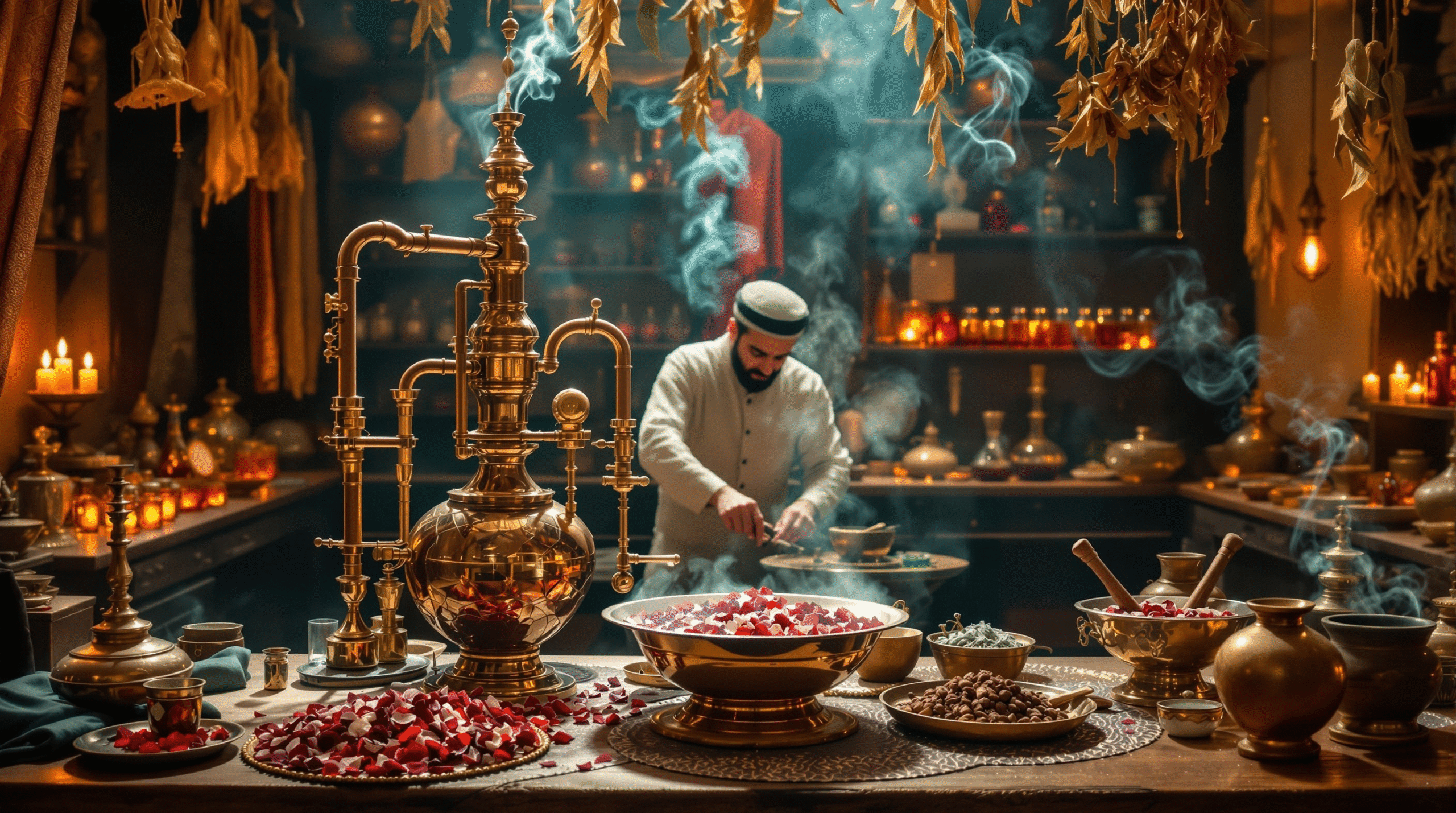
Have you ever wondered how master perfumers create those magical Arabian fragrances that last all day? The secret isn’t in fancy chemicals or modern factories—it’s in ancient techniques passed down through generations, where copper pots bubble over wood fires, flowers soak in precious oils, and patience transforms simple ingredients into liquid gold.
Traditional perfume making in the Arab world is more than just a craft—it’s a living art form that connects us to thousands of years of cultural heritage. From the bustling souks of Damascus to the family workshops of Oman, master perfumers still use time-honored methods that their great-great-grandparents would recognize. These aren’t museum pieces gathering dust—they’re vibrant techniques creating some of the world’s most sought-after perfumes today!
Ready to step inside a traditional perfume workshop and discover the secrets behind those intoxicating Arabian scents? Let’s explore six authentic techniques that transform flowers, woods, and resins into the perfumes that have captivated the world for centuries. By the end of this journey, you’ll understand exactly what makes traditional Arabian perfumes so special—and how to recognize the real deal!
- I. Foundation: Understanding Arabian Perfume-Making Philosophy
- II. Traditional Technique #1: Steam Distillation (Deg-Bhapka Method)
- III. Traditional Technique #2: Cold Enfleurage
- IV. Traditional Technique #3: Hot Maceration
- V. Traditional Technique #4: Expression (Cold-Pressing Citrus)
- VI. Traditional Technique #5: Tincturing with Alcohol
- VII. Traditional Technique #6: Bakhoor Making (Incense Perfumery)
- VIII. The Art of Blending: Master Perfumer Secrets
- IX. Regional Specialties: How Location Shapes Techniques
- X. Modern Adaptations: Keeping Traditions Alive Today
- XI. Recognizing Authentically Traditional Perfumes
- CONCLUSION: Keeping Ancient Wisdom Alive
I. Foundation: Understanding Arabian Perfume-Making Philosophy
Why Arabian Perfume-Making is Different
Before we dive into techniques, let’s talk about what makes Arabian perfume-making unique. It’s not just about different ingredients—it’s a completely different philosophy!
Think of Western perfumery like fast food: Quick, convenient, consistent. Modern factories can produce thousands of identical bottles in a day using synthetic chemicals. Nothing wrong with that—it serves its purpose! But traditional Arabian perfumery? That’s like a grandmother’s slow-cooked family recipe, where every ingredient is chosen with care, every step takes time, and no two batches are exactly the same.
Here are the key differences that define Arabian perfume-making:
Oil-Based vs. Alcohol-Based: Most Western perfumes use alcohol as the base—spray it on, and it evaporates quickly, taking the scent with it. Arabian perfumes traditionally use oils as the base. Why does this matter? Oil-based perfumes don’t evaporate! They sink into your skin, warm with your body heat, and release fragrance slowly over 8-12 hours. In the hot Arabian climate, this makes perfect sense—alcohol would evaporate in minutes!
Natural Over Synthetic: Western perfumery discovered how to create synthetic molecules that smell like roses, vanilla, or musk without using the actual ingredients. Cheaper and faster! But traditional Arabian perfumers insist on the real thing. Real rose oil from 60,000 rose petals. Real oud from infected agarwood trees. Real frankincense resin. The difference? Natural ingredients create complex, evolving scents that synthetic molecules can’t quite replicate.
Patience as an Ingredient: Here’s where it gets really interesting. Western perfumery wants products ready to ship tomorrow. Traditional Arabian perfumers believe aging improves perfume just like fine wine. A blend might rest for 40 days—or 40 weeks—before it’s ready. Rushed perfume is considered inferior perfume. Time itself becomes an ingredient!
Layering and Complexity: Western thinking: One perfume bottle, one complete fragrance. Arabian thinking: Multiple layers create your signature scent! First, oil-based attar on your skin. Then, clothes fumigated with bakhoor smoke. Finally, alcohol-based perfume sprayed on top. Each layer adds depth and creates a scent uniquely yours. No one else smells quite the same!
Fragrance as Spiritual Practice: In the West, perfume is cosmetic—nice to have, but optional. In Arabian culture, fragrance is part of religious devotion and cultural identity. Prophet Muhammad encouraged wearing perfume before prayers. Burning incense purifies spaces. Offering perfume to guests shows respect. This spiritual dimension means perfume-making carries deep responsibility!
The Master Perfumer’s Skillset
What makes someone a master perfumer in the Arab world? It’s not a degree from a fancy school (though education helps!). It’s knowledge passed through generations, often within families who’ve made perfume for centuries.
A master perfumer can:
Identify quality by the senses alone. Pick up a chunk of agarwood? They know instantly if it’s Grade A from Cambodia or Grade C from India—by sight, smell, and even how it feels in their hand. Smell a rose oil? They can tell you which region the roses came from and whether the distillation was done correctly. This takes decades of training!
Blend with intuition. Sure, they know the formulas. But the real magic happens when they adjust “by feel”—adding a drop more rose here, a whisper of saffron there, until the blend feels right. It’s like a jazz musician improvising—knowledge combined with instinct.
Understand climate and skin chemistry. That gorgeous perfume in January might be too heavy in July. That blend perfect for your dry skin might overwhelm someone with oily skin. Master perfumers create different seasonal blends and adjust formulas for individual customers. Personal perfume consultation is still common in traditional workshops!
Respect spiritual and cultural significance. Ingredients aren’t just commodities—they carry meaning. Frankincense has religious significance. Oud symbolizes luxury and hospitality. Rose represents love and beauty. A master perfumer honors these connections, creating fragrances that resonate culturally and spiritually.
Balance tradition with innovation. The best traditional perfumers aren’t rigid purists. They respect ancestral techniques while carefully adopting modern improvements that enhance quality without compromising authenticity. It’s evolution, not revolution!
Key Principles of Traditional Arabian Perfume-Making
Before we explore specific techniques, understand these guiding principles:
“Slow Perfumery” Creates Quality: Rush a distillation, and you get harsh, burning notes. Take your time, and flowers surrender their soul. Good perfume cannot be hurried. Period.
Less is More: Traditional attars are incredibly concentrated. One tiny drop contains the essence of hundreds of flowers. You don’t slather it on—you dab it on pulse points where it blooms with your body heat. Concentrated power beats watered-down volume!
Seasonality Matters: Different seasons call for different scents. Heavy, resinous oud perfumes for winter. Light, floral rose blends for spring. Traditionally, perfumers created seasonal collections long before Western fashion brands made it trendy!
Every Perfumer Has a Signature: Visit ten different traditional perfumers, ask for “rose attar,” and you’ll get ten different interpretations. Each adds their personal touch—maybe a hint of cardamom, a base of vetiver, a drop of their secret ingredient. This individuality is celebrated, not standardized away!
Now that you understand the philosophy, let’s get our hands dirty (metaphorically!) and explore the actual techniques!
II. Traditional Technique #1: Steam Distillation (Deg-Bhapka Method)
What Is It?
Imagine capturing the soul of a thousand roses in a single bottle. That’s exactly what steam distillation does! This ancient technique, perfected in India and the Middle East over 4,000 years ago, uses steam to coax essential oils from flowers, herbs, and woods without burning or destroying them.
The traditional equipment is called the deg-bhapka system—copper vessels connected by bamboo pipes, heated over wood fires, producing some of the purest essential oils on Earth. Even today, artisan perfumers swear nothing produces finer attars than this time-tested method!
The Equipment: A Symphony of Copper and Bamboo
Let’s meet the players in this aromatic orchestra:
The Deg (Copper Still): This large copper pot is where the magic begins! It holds the flowers, herbs, or wood chips, completely covered with water. Why copper? Copper conducts heat evenly and doesn’t react with essential oils, keeping fragrances pure. A good deg might hold 50-100 kilograms of fresh flowers!
The Chonga (Bamboo Condenser): Here’s where it gets fascinating—a hollow bamboo pipe connects the deg to the receiver. As fragrant steam travels through the bamboo, the bamboo itself adds subtle woody notes to the final product. This is why traditionally distilled attars have a warmth that modern distillation can’t quite replicate!
The Bhapka (Receiver): This smaller copper vessel sits in a cooling water bath. It contains the “base oil”—traditionally sandalwood oil. As the fragrant steam enters and cools, the essential oils dissolve into the sandalwood base, creating the finished attar. Genius, right?
The Bhatti (Furnace): Traditional deg-bhapka uses wood fire, not gas or electric heat. Why does this matter? Wood fire provides gentle, fluctuating heat that somehow produces rounder, softer notes than modern heat sources. Old-school perfumers claim they can taste the difference!
The Gachchi (Cooling Tank): A simple but crucial water bath keeps the bhapka cool so steam can condense. Change the water regularly, keep it cold, and the oils flow beautifully!
Step-by-Step: How Roses Become Attar
Let me walk you through making traditional rose attar—one of the most beloved Arabian perfumes:
Step 1: Dawn Harvest (The 5 AM Rush)
Master perfumers or their workers arrive at rose fields before sunrise. Why so early? Rose fragrance is strongest just before dawn, when the petals hold maximum essential oil. As soon as the sun hits them, oils start evaporating. You’ve got maybe a 2-hour window! Workers gently hand-pick roses, handling them like precious gems because bruised petals lose fragrance.
Step 2: Loading the Deg
Fresh roses go into the deg immediately—no waiting! They’re layered carefully with water covering them completely. Traditionally, the ratio is about 1 part roses to 2 parts water, but master perfumers adjust by feel. Some add a pinch of salt (secret trick!) to help extract oils.
Step 3: The Sacred Sealing
Here’s something beautiful: The deg lid is sealed with a paste made from clay mixed with wheat flour. This isn’t just practical—it’s ritual. As the paste hardens, it creates an airtight seal preventing any precious steam from escaping. Some perfumers whisper prayers or blessings during this step. The seal won’t be broken until distillation completes—sometimes 12 hours later!
Step 4: Gentle Fire, Patient Hearts
Wood fire is lit beneath the deg, and now patience becomes essential. The water must come to a gentle simmer—not a rolling boil! Boiling burns the roses, creating harsh notes. Simmering coaxes out the fragrance gently. The perfumer tends the fire all day, adding wood carefully, never letting temperature spike.
You can tell an experienced distiller by how they manage the fire. Too hot? The attar smells sharp and chemical. Too cool? You don’t extract enough oil. It’s an art learned over years of practice!
Step 5: The Fragrant Journey
As the deg water simmers, steam rises through the roses, capturing their essential oils. This fragrant steam travels through the bamboo chonga into the bhapka, which sits in cold water. Here’s the magic moment: The steam hits the cool sandalwood oil in the bhapka and condenses instantly. Rose essential oils dissolve into the sandalwood, creating rose attar!
Watch the bhapka closely. You’ll see tiny droplets forming, shimmering like liquid jewels. This is the “tears of the rose”—what ancient perfumers called the distillate. Absolutely mesmerizing!
Step 6: Repeat, Repeat, Repeat
One distillation isn’t enough for premium attar! The same sandalwood oil goes back in the bhapka, and fresh roses go in the deg. The process repeats 7, 10, even 15 times over several days. Each distillation layers more rose essence into the sandalwood base, creating incredibly concentrated, long-lasting attar.
Premium rose attar might contain the essence of 60,000 roses in a single 10ml bottle!
Step 7: The Aging Miracle
Once distillation completes, you might think the attar is ready. Not even close! Freshly distilled attar smells sharp, almost alcohol-like. Now it needs to rest in sealed copper or glass vessels for minimum 40 days. During aging, the harsh notes mellow, the fragrance deepens, and everything harmonizes beautifully.
Some master perfumers age their finest attars for a full year before selling them. Good things come to those who wait!
What Makes Steam Distillation Special?
Purest possible extraction: No chemicals, no solvents—just water, steam, and time. What you get is as natural as it gets!
Wood-fire magic: That gentle, fluctuating wood heat creates aromatic notes impossible to achieve with modern heat sources. Perfumers who’ve tried both swear by wood fire.
Sandalwood synergy: Collecting oils directly into sandalwood base creates instant attar. The sandalwood doesn’t just hold the rose—it enhances it, adding warmth and depth. Two fragrances become one harmonious whole!
Cultural continuity: This technique is virtually unchanged for 4,000 years. When you smell deg-bhapka rose attar, you’re experiencing exactly what ancient kings and queens enjoyed. History in a bottle!
Time Investment & Results
Active time per batch: 12-15 hours of distillation, repeated multiple times
Total time with aging: 2-4 months from fresh flowers to finished attar
Yield: Incredibly low—maybe 5ml of attar from 10kg of roses!
What it produces: Rose attar, jasmine attar, vetiver attar, khus attar, mogra attar
Price reality: Now you understand why traditional attars cost $100-$500 for a tiny bottle. You’re paying for months of work, tons of flowers, and irreplaceable expertise!
III. Traditional Technique #2: Cold Enfleurage
What Is It?
Enfleurage is the perfume world’s most romantic technique—and also the most labor-intensive! Imagine this: delicate jasmine flowers resting on beds of pure fat, slowly releasing their precious fragrance over weeks. No heat. No pressure. Just time and patience.
This ancient French technique (adopted enthusiastically by Arabian perfumers) is reserved for the most precious flowers—ones so delicate that even gentle steam would destroy their fragrance. We’re talking jasmine, tuberose, and the finest roses. The resulting “absolutes” are liquid poetry—the truest-to-life floral scents possible!
The Equipment
Glass chassis (frames): Shallow wooden frames with glass plates inside. Think of them like large picture frames laid flat. High-quality workshops have dozens of these!
Purified fat: Traditionally, odorless animal fat (lard) from specific cuts. Today, many Arabian perfumers use coconut oil or shea butter—it works beautifully and aligns with Islamic principles. The fat must be completely odorless or it interferes with the flowers!
Fresh linen cloths: For handling flowers without touching them with warm hands (which would cause them to release oils prematurely).
Pure alcohol: High-proof ethanol for extracting the final fragrance from the saturated fat.
Patience: Lots and lots of patience! This cannot be rushed.
Step-by-Step: How Jasmine Surrenders Its Soul
Let me walk you through making jasmine absolute—one of perfumery’s crown jewels:
Step 1: Fat Preparation
The fat (or coconut oil) is purified multiple times to remove any traces of odor. It’s then spread thinly—about 1-2mm thick—across the glass plates in the chassis. The layer must be perfectly smooth and even. Some perfumers use special wooden spatulas that have been in their families for generations!
Step 2: Flower Placement (The 9 PM Ritual)
Here’s something fascinating: Jasmine releases maximum fragrance at night! So traditional enfleurage is done in the evening. Freshly picked jasmine flowers are placed face-down on the fat, spaced evenly so they don’t touch each other. Each flower is positioned carefully using tweezers or linen cloth—never bare hands.
How many flowers? For a standard chassis, about 800-1,000 jasmine blossoms. That’s just for one night!
Step 3: The Waiting (24-48 Hours)
The chassis are stacked in a cool, dark room. No peeking! Over the next day or two, the fat slowly absorbs the jasmine’s essential oils. You can actually smell the fat becoming more and more fragrant. The room where this happens smells absolutely heavenly!
Step 4: Flower Removal
After 24-48 hours, the flowers have given everything they have. They look wilted and pale—their essence transferred to the fat. Workers carefully remove each spent blossom using tweezers. These are composted, not wasted (some perfumers say they make amazing fertilizer!).
Step 5: The Endless Repetition
Now fresh jasmine flowers go on the same fat. Then again. Then again. This process repeats 10, 20, sometimes 30 times over several weeks until the fat is completely saturated with jasmine essence.
How do you know when it’s saturated? The fat changes color (usually becoming slightly darker) and stops absorbing fragrance as quickly. Experienced perfumers can tell by smell when the fat has reached its limit.
Step 6: Creating the Pomade
The finished product at this stage is called “pomade”—fragrance-saturated fat. Some customers buy it as-is! Pomade can be used directly as a solid perfume. You warm a tiny bit between your fingers and apply it to pulse points. Incredibly long-lasting!
But if you want liquid perfume, there’s one more crucial step…
Step 7: Alcohol Extraction
The pomade is cut into chunks and immersed in pure ethanol. The alcohol is shaken or stirred regularly for several days. Here’s the chemistry magic: Alcohol dissolves the fragrance oils but not the fat! After 5-7 days, you strain out the fat, leaving alcohol infused with pure jasmine essence.
Step 8: Evaporation & Aging
The alcohol is allowed to slowly evaporate in sealed containers (you don’t want to lose the fragrance!). As alcohol evaporates, it leaves behind concentrated jasmine absolute—the purest, most expensive form of jasmine fragrance money can buy.
This absolute is then aged for several months. Yes, even more patience required! But aging transforms it from good to extraordinary.
What Makes Enfleurage Special?
Cold process preserves everything: Steam distillation can destroy some delicate fragrance molecules with heat. Cold enfleurage captures every single aromatic compound the flower produces—nothing is lost!
Most true-to-life scent: Smell a real jasmine flower, then smell jasmine absolute from enfleurage. They’re almost identical! No other extraction method comes this close to capturing the living flower’s scent.
Labor of love: The time, attention, and sheer work involved makes enfleurage products incredibly valuable. You’re not just paying for perfume—you’re paying for someone’s patient devotion over weeks of meticulous work!
Arabian adaptation: Some Arabian perfumers do a beautiful twist—they use pure ghee (clarified butter) instead of lard. This aligns with Islamic dietary principles and adds a subtle, creamy warmth to the final fragrance!
Time Investment & Results
Active time: A few hours daily for flower placement and removal
Total time: 3-6 weeks for saturation, plus aging time
Yield: Heartbreakingly low—maybe 10ml of absolute from thousands of flowers
What it produces: Jasmine absolute, tuberose absolute, premium rose absolute
Why it’s rare: Most perfume companies can’t justify the cost and time. When you find true enfleurage jasmine, treasure it—you’re holding something genuinely precious!
IV. Traditional Technique #3: Hot Maceration
What Is It?
If enfleurage is gentle persuasion, maceration is warm encouragement! This technique uses heated carrier oil to coax fragrance from materials that need a little warmth to open up—resins, woods, spices, and dried flowers.
Think of it like making tea, but instead of water, you’re using oil, and instead of brief steeping, you’re letting everything infuse for days or weeks. The result? Rich, warm, complex perfume oils perfect for the heavy, sensual fragrances Arabian culture loves!
The Equipment
Copper or glass vessels: Must be non-reactive so they don’t alter the fragrance. Copper is traditional and conducts heat beautifully. Glass lets you watch the process (oddly satisfying!).
High-quality carrier oil: Jojoba oil is excellent—it’s actually a liquid wax that doesn’t go rancid! Sweet almond oil works too. Some traditional perfumers use sesame oil for its stability in hot climates.
Gentle heat source: Traditionally, a water bath (bain-marie) over low fire. Think of it like a double boiler—the vessel sits in simmering water, so oil heats gently without burning.
Muslin cloth or fine strainer: For filtering out plant materials after infusion.
Dark bottles: For storing the finished oil away from light.
Step-by-Step: Creating Amber Maceration
Let me show you how traditional Arabian amber perfume oil is made:
Step 1: Ingredient Preparation
Amber isn’t actually one thing—it’s a blend! Traditional Arabian amber typically includes:
- Labdanum resin (rockrose)
- Benzoin resin
- Vanilla beans
- Sometimes: patchouli, cistus, small amounts of ambergris
These ingredients are broken into small pieces or coarsely ground. Don’t powder them! Powder can cloud the oil and be hard to filter out.
Step 2: Oil Warming
Your carrier oil goes into the vessel, which sits in a water bath. The water simmers gently, bringing the oil to about 40-60°C (104-140°F). You want warm, not hot! Stick your finger in—it should feel like a warm bath, not painful. Some traditional perfumers judge temperature by feel alone!
Step 3: Infusion Begins
Prepared resins and botanicals are added to the warm oil. They sink in, releasing their fragrances. Within minutes, the oil starts smelling incredible! The workspace fills with rich, sweet, ambery aroma that makes everyone smile.
Step 4: The Long Steep
Now the mixture sits in its warm bath for 6-12 hours, stirred occasionally. You’re not cooking it—you’re coaxing it! The gentle heat helps resins dissolve and botanicals release their essential oils into the carrier oil.
Some perfumers keep the heat on continuously. Others heat for a few hours, let it rest, then reheat. There’s no “right” way—each master perfumer has their preferred method!
Step 5: Straining
After the first infusion, strain out the spent botanicals through muslin cloth. The oil is now lightly scented. But we’re not done! Real depth comes from repetition.
Step 6: Repeat with Fresh Ingredients
Fresh resins and botanicals go into the now-fragrant oil. Heat again. Infuse again. Each cycle layers more scent into the oil. Premium amber oils might undergo 5-7 macerations with fresh ingredients each time!
Step 7: Cooling & Settling
Once you’re satisfied with the depth of fragrance (trust your nose!), remove from heat and let cool slowly—never shock it by cooling too fast. Slow cooling lets sediment settle naturally. The oil rests for 3-7 days, allowing tiny particles to sink to the bottom.
Step 8: Decanting & Aging
Carefully pour the clear oil off the top, leaving sediment behind. Transfer to dark bottles and age for minimum 2-4 weeks. With maceration, aging is crucial! Fresh macerated oil smells sharp and unbalanced. After a month, everything harmonizes beautifully.
What Makes Hot Maceration Special?
Extracts warm, deep notes: Resins and woods need warmth to release their full fragrance profile. Cold methods miss these rich base notes!
Creates ready-to-use perfumes: Unlike distillation (which produces concentrated essentials oils that need diluting), maceration produces perfume oils at the perfect strength to wear directly!
Oil’s own properties shine: Jojoba oil has natural fixative properties—it helps perfume last longer on skin. Sesame oil adds nutty warmth. The carrier becomes part of the fragrance!
Versatile technique: Works for almost anything—florals, resins, woods, spices, even fruits! Want orange blossom oil? Macerate fresh blossoms. Want spiced oud? Macerate agarwood with cardamom and cinnamon!
Arabian specialty: While other cultures use maceration, Arabian perfumers are absolute masters of complex multi-ingredient macerations that smell unlike anything else!
Time Investment & Results
Active time per cycle: 6-12 hours of heating/steeping
Total cycles: 3-7 cycles for premium oils
Aging time: 1-3 months
Yield: Good! Unlike distillation, you get usable product equaling nearly all the oil you started with
What it produces: Amber oils, oud blends, spiced perfumes, floral macerations, musk blends
Perfect for: Base notes and heavy, long-lasting perfumes beloved in Arabian culture!
V. Traditional Technique #4: Expression (Cold-Pressing Citrus)
What Is It?
Expression is perfumery’s simplest, oldest technique—and somehow still one of the best! No heat, no steam, no solvents. Just pure mechanical pressure squeezing precious oils from citrus peels. Squeeze an orange peel near a candle flame and watch it shoot out fragrant oil? That’s expression!
This ancient method produces the brightest, freshest, most vibrant citrus oils—perfect for the top notes in Arabian perfumes. The technique is thousands of years old, dating back to when ancient perfumers discovered citrus peels were packed with aromatic oils!
The Equipment
Écuelle à piquer (traditional bowl): A wooden or metal bowl covered with sharp spikes. Citrus peels are pressed against these spikes, bursting the tiny oil sacs in the peel.
Sponge or cloth: Natural sponge absorbs the oil-water mixture that drips out when peels are pressed.
Collection vessel: Simple container catching the precious liquid when the sponge is wrung out.
Modern adaptation: Small hydraulic presses or even hand-cranked fruit presses work too! The principle remains identical—pressure releases oils.
Step-by-Step: From Peel to Perfume
Step 1: Harvest & Peel
Fresh citrus fruits are picked (or bought from markets). Freshness is crucial—the fresher the fruit, the more oil in the peels! The fruits are carefully peeled, keeping the outer zest layer intact. The white pith underneath is left behind—it contains bitter compounds you don’t want.
Step 2: Manual Pressing
The fresh peels are pressed firmly against the spiked bowl (or through a press). You’ll actually see and smell the oils bursting out! Tiny droplets of fragrant oil spray everywhere. It smells absolutely fantastic—bright, sharp, energizing!
Traditional perfumers do this by hand, pressing and turning each peel to extract maximum oil. It’s surprisingly hard work! Your forearms get a workout!
Step 3: Collection
As peels are pressed, oil and some juice drip down into the bowl. A natural sponge soaks up this liquid mixture. Once the sponge is saturated, it’s wrung out into a collection vessel. The liquid is cloudy—it contains both oil and water (juice).
Step 4: Separation
Here’s the easy part: citrus oils are lighter than water, so they naturally float on top! Pour the mixture into a separating funnel or simply let it sit in a narrow-necked bottle. After a few hours, you’ll see clear stratification—oil on top, water below.
Carefully pour off or siphon out the top layer of pure citrus oil. The water-juice layer goes to waste (or clever perfumers use it for cooking—waste not!).
Step 5: Quick Filtration
Pass the oil through a simple coffee filter or cheesecloth to remove any tiny pieces of pulp. That’s it! You’re done! Expression produces finished product incredibly quickly compared to other methods.
Step 6: Immediate Use or Preservation
Here’s the catch with citrus oils: They oxidize rapidly. Exposed to air and light, they degrade in weeks or months. That’s why traditional perfumers either use them immediately in blends or store them carefully in dark, completely full bottles (no air space) in cool conditions.
Some perfumers add a tiny amount of natural vitamin E (tocopherol) as an antioxidant to extend shelf life. But ultimately, citrus oils are meant to be used fresh!
What Makes Expression Special?
No heat = perfect freshness: Heat changes citrus fragrance, making it smell “cooked.” Cold expression captures the fruit exactly as nature made it—sparkling, zesty, alive!
Food-grade purity: Since no chemicals or solvents are used, expressed citrus oils are edible (and often used in cooking!). You’re literally squeezing fruit—doesn’t get more natural!
Quick & simple: Unlike distillation (hours) or enfleurage (weeks), expression produces finished product in one afternoon! It’s beautifully straightforward.
Essential for top notes: Arabian perfumes often layer heavy base notes (oud, amber) with bright citrus top notes for balance. Expressed citrus oils provide that sparkle!
Time Investment & Results
Active time: 2-4 hours from fresh fruit to finished oil
Aging: None needed—use fresh for best results!
Yield: Moderate—1kg of orange peels yields about 4-6ml of oil
What it produces: Orange oil, lemon oil, bergamot oil, grapefruit oil, lime oil, bitter orange oil
Perfect for: Top notes, soap-making, food flavoring, and adding brightness to heavy perfumes!
VI. Traditional Technique #5: Tincturing with Alcohol
What Is It?
Tincturing is the perfumer’s secret weapon for materials that won’t surrender their fragrance to water, steam, or oil. Resins like frankincense and myrrh? They laugh at steam distillation! Precious ambergris? Too valuable to distill! Animal musks, dried vanilla beans, exotic spices? Alcohol extracts them all beautifully.
This technique uses high-proof ethanol to dissolve aromatic compounds, creating concentrated “tinctures” that form the soul of many traditional Arabian perfumes. It’s like making herbal medicine, but for your nose instead of your body! The patience required? Measured in months, not days. But the results? Absolutely worth the wait!
The Equipment
Dark glass bottles: Absolutely essential! Light degrades both alcohol and aromatics. Amber or cobalt blue bottles are traditional.
95% ethanol (perfumer’s alcohol): Must be high-proof and undenatured (no additives). Some traditional perfumers use grape alcohol or date alcohol.
Cheesecloth or muslin: For straining out solid materials after infusion.
Cool, dark storage: A cupboard, cellar, or cool closet away from temperature fluctuations.
Labels: Trust me, label everything! With multiple tinctures aging for months, you’ll forget what’s what!
Step-by-Step: Creating Amber Tincture
Let me show you how traditional amber tincture is made—the base of countless Arabian perfumes:
Step 1: Material Preparation
Traditional amber tincture combines several resins. A typical formula:
- 30g labdanum resin
- 20g benzoin resin
- 10g crushed vanilla beans
- 5g crushed tonka beans
- Optional: 1-2g real ambergris (if you’re lucky enough to have it!)
The resins are broken into small chunks (not powder—powders create sediment issues). Vanilla and tonka beans are crushed or cut into pieces. The goal is maximum surface area for alcohol contact!
Step 2: Immersion
Materials go into a large glass bottle (or jar—mason jars work!). Cover completely with perfumer’s alcohol—at least 3-4 times the volume of the solids. So 65g of materials needs minimum 250ml of alcohol. Many perfumers use even more to create less concentrated tinctures they can work with more easily.
Seal the bottle tightly! You don’t want alcohol evaporating!
Step 3: The First Week (Daily Shaking)
For the first 7 days, shake the bottle vigorously once or twice daily. This accelerates extraction. You’ll see the clear alcohol gradually turning amber-colored as resins dissolve. The smell evolves from sharp alcohol to complex, resinous sweetness.
This daily ritual is meditative—many traditional perfumers say it connects them to their creations!
Step 4: The Long Rest (4-8 Weeks Minimum)
After the first week, stop shaking and let the tincture rest undisturbed in cool darkness. Now patience becomes essential. Over weeks, the alcohol extracts every molecule of fragrance from the materials.
Check it once a week—smell the cap (never open and expose to air unless necessary!). You’ll notice the fragrance deepening, mellowing, becoming more complex. This is aging magic happening!
Most traditional perfumers tin cture for minimum 6 weeks, ideally 3 months. Some precious tinctures age for a full year!
Step 5: First Straining
After your patience period, strain the tincture through several layers of cheesecloth. Squeeze the solids to extract every drop of fragrant alcohol! Those spent resins still hold precious tincture!
What you have now is “young tincture”—usable but not yet mature.
Step 6: Settling & Clarification
The strained tincture sits again for 1-2 weeks. Any tiny particles settle to the bottom. Carefully decant (pour off) the clear tincture from the top, leaving sediment behind.
Some perfumers filter through coffee filters for crystal-clear tinctures. This is optional—slight cloudiness doesn’t affect fragrance quality!
Step 7: Final Aging (The Patience Continues!)
The clarified tincture goes into dark bottles, sealed tightly, and ages another 2-6 months. Yes, really! With tinctures, more aging = more magic!
During this final aging, harsh alcohol notes fade, rough edges smooth out, and everything harmonizes beautifully. A 6-month-old tincture smells dramatically better than a 6-week-old one!
Step 8: Blending or Using
Your finished tincture is incredibly concentrated—often 10-20% fragrance compounds! It’s used as an ingredient in perfume blends, not worn alone (unless you want to smell like pure resin!).
Traditional Arabian perfumes might contain 5-10 different tinctures blended together, creating phenomenal complexity!
What Makes Tincturing Special?
Extracts the impossible: Materials that resist other methods surrender to alcohol. Resins, dry flowers, vanilla, precious animal aromatics—alcohol captures them all!
Creates perfume bases: Tinctures are concentrated building blocks perfumers blend into final perfumes. They’re the perfumer’s paint colors!
Aging dramatically improves quality: Unlike citrus oils (which degrade), tinctures actually get better with age! Some perfumers have tinctures aging for years.
Preserves tradition: Many historical Arabian perfume formulas relied on tinctures. When you use this technique, you’re directly connecting to centuries of perfume-making heritage!
Cost-effective for precious materials: When ambergris costs $50-100 per gram, you can’t waste a single molecule! Tincturing extracts everything, making expensive ingredients go further.
Time Investment & Results
Active time: 1-2 hours preparing materials and bottling
Minimum maceration: 6 weeks
Ideal aging: 3-6 months (or longer!)
Yield: Excellent—you get nearly all the alcohol back, now concentrated with fragrance
What it produces: Amber tinctures, musk tinctures, frankincense tinctures, benzoin, vanilla, ambergris, labdanum
Perfect for: Base notes, fixatives, and creating complex, long-lasting Arabian perfume blends!
VII. Traditional Technique #6: Bakhoor Making (Incense Perfumery)
What Is Bakhoor?
Bakhoor is where perfumery meets home fragrance meets cultural ritual! These perfumed wood chips, burned like incense, are absolutely essential to Arabian home life. Every family has their secret recipe, passed down through generations. Walk into any Arabian home, and you’ll smell bakhoor—it’s the scent of hospitality, tradition, and belonging.
Unlike liquid perfumes you wear on skin, bakhoor is for fumigating spaces and clothes. But make no mistake—this is serious perfumery! Creating excellent bakhoor requires the same skills, ingredients, and patience as making liquid perfumes. Maybe more!
Traditional Ingredients
A basic bakhoor recipe includes:
Base Woods:
- Sandalwood chips: The classic base, adds creamy sweetness
- Agarwood pieces (oud): For luxury bakhoor, adds depth
- Cedar wood: Less expensive option, still fragrant
Resins (The Soul of Bakhoor):
- Frankincense: Citrusy, piney, spiritually significant
- Myrrh: Warm, slightly bitter, grounding
- Benzoin: Vanilla-like sweetness
Aromatics:
- Dried rose petals: Floral sweetness
- Saffron threads: Luxurious, slightly spicy
- Cardamom pods: Warm, sweet spice
- Crushed cloves: Pungent warmth
- Dried orange peel: Bright citrus notes
Binders:
- Sugar syrup or honey: Traditional binding agent
- Natural gums: Acacia, tragacanth
- Makko powder (modern): Natural tree bark binder
Perfume Oils:
- Oud oil: Rich, complex, long-lasting
- Rose oil: Floral heart
- Musk oil: Animalic depth
- Amber oil: Sweet warmth
Step-by-Step: Creating Family Bakhoor
Let me walk you through making traditional Gulf-style bakhoor:
Step 1: Wood Preparation (The Night Before)
Sandalwood chips are soaked overnight in rosewater. This serves multiple purposes: The wood absorbs rose fragrance, becomes softer (easier to bind), and the moisture prevents it from burning too quickly later. Some families add a few drops of precious oud oil to the rosewater—talk about luxury!
By morning, the wood chips smell incredible and are ready for the next steps!
Step 2: Resin Grinding (The Meditation)
Frankincense and myrrh chunks go into a traditional mortar and pestle. Grinding resins is meditative work—the rhythmic pounding, the rising fragrance, the gradual transformation from rocks to powder. Many perfumers say this is their favorite step!
Don’t grind to fine powder—coarse powder works better. You want texture in your final bakhoor, not dust!
Step 3: Spice & Aromatic Preparation
Cardamom pods are opened and seeds removed. Cloves are crushed. Saffron threads are left whole (they’re delicate!). Dried rose petals are crumbled between fingers. Everything is measured according to your family recipe—or experimentation if you’re creating a new blend!
This step smells amazing. Your workspace becomes a symphony of fragrances!
Step 4: Dry Mixing (Finding Balance)
All dry ingredients—ground resins, crushed spices, dried flowers—go into a large bowl. Mix thoroughly with clean hands (many perfumers insist hands work better than spoons—you can feel when mixing is complete!).
This is where the art happens: Adjusting ratios, maybe adding more rose or less cardamom, trusting your nose. Some bakhoor makers taste tiny amounts (yes, really!) to judge spice balance!
Step 5: Oil Addition (Layering Complexity)
The soaked wood chips are drained (save that rosewater!) and added to the dry mixture. Now comes the perfume oils—oud oil, rose oil, musk, amber—drizzled carefully over everything.
Start with less oil than you think you need! You can always add more, but too much makes the mixture goopy and hard to work with. Traditional ratio is about 5-10ml of oil per 100g of dry materials.
Mix thoroughly but gently. You want oils distributed evenly without crushing the wood chips. This takes 5-10 minutes of patient mixing.
Step 6: Syrup Binding (The Sticky Part)
Here’s where it gets fun (and messy!). Sugar syrup is made by dissolving sugar in that rose water from soaking the wood. The syrup needs to be hot and sticky—like honey consistency.
Slowly drizzle hot syrup over the mixture while stirring constantly. The goal is to add just enough that everything holds together when squeezed, but not so much that it becomes a wet paste. This is learned through experience—your hands will tell you when it’s right!
The mixture should feel like damp sand that holds its shape when pressed—not wet, not dry, just perfect!
Step 7: Shaping (Creativity Unleashed)
Traditional bakhoor comes in various forms:
- Chips: Simply spread mixture on trays to dry
- Balls: Roll into marble-sized spheres
- Cones: Shape into incense cones
- Pressed blocks: Pack into molds
Many families have special molds passed down through generations—maybe a geometric pattern, a family symbol, or decorative shapes. Pressing bakhoor into shapes is often a family activity, with children helping!
Step 8: Drying (Patience, Again!)
Shaped bakhoor is laid out on trays lined with parchment paper. This must dry in a shaded, well-ventilated area—never in direct sunlight (which would destroy fragrance).
Depending on humidity, drying takes 1-3 weeks. You’ll know it’s ready when the bakhoor pieces are completely hard and dry to the touch, with no soft centers.
Resist the urge to rush this! Inadequately dried bakhoor molds (gross) or doesn’t burn properly.
Step 9: Aging (The Final Touch)
Once fully dry, bakhoor is stored in sealed containers for minimum 1 month before use. Just like liquid perfumes, aging harmonizes all the ingredients. Fresh bakhoor smells sharp and unbalanced. Aged bakhoor? Pure magic!
Many families make large batches that age for 6 months or even years. The older, the better! Some perfumers have bakhoor from their grandmother’s time—still fragrant, still treasured!
Step 10: Burning Ritual (The Moment of Truth)
When it’s finally time to use your bakhoor:
- Light a charcoal disk in a bakhoor burner (mabkhara)
- Wait until charcoal is glowing red (about 5 minutes)
- Place one small piece of bakhoor on the hot charcoal
- Watch the fragrant smoke rise!
The smoke carries the complex fragrance throughout your home. Hold clothes over the burner to absorb the scent. Run your fingers through your hair in the smoke. Let it perfume every room.
This is bakhoor’s magic—it’s not just fragrance, it’s ritual, connection, home.
What Makes Bakhoor Special?
Most personal perfumery: Every family creates their own blend reflecting their taste, heritage, and creativity. No two families’ bakhoor smells identical!
Social/spiritual significance: Burning bakhoor welcomes guests, purifies spaces before prayer, celebrates special occasions. It’s fragrance with meaning!
Long-lasting impact: One piece of bakhoor can perfume an entire house for hours. Clothes fumigated with bakhoor smell incredible for days! Extremely concentrated fragrance!
Creative expression: Bakhoor-making lets perfumers experiment endlessly. Want smoky-spicy? Add more cloves and oud. Prefer sweet-floral? Increase rose and vanilla. The possibilities are endless!
Community activity: Making bakhoor is often done together—families, friends, neighbors. It’s social bonding through perfume-making!
Regional Variations
Gulf Style (UAE, Saudi, Oman):
- Heavy oud content (very rich!)
- Prominent amber notes
- Less floral, more woody-resinous
- Dark, intense, long-lasting
Levantine Style (Syria, Lebanon, Jordan):
- Rose-forward blends
- More frankincense, less oud
- Brighter, lighter overall
- Floral-resinous balance
North African Style (Morocco, Egypt):
- Amber and spice dominant
- Exotic spices (cinnamon, anise)
- Often uses local herbs (lavender, rosemary)
- Warm, spicy, herbal
Time Investment & Results
Active time: 3-4 hours for mixing and shaping
Drying time: 1-3 weeks
Aging time: 1-6 months (or longer!)
Yield: Variable—a batch might produce 500g to several kilograms
Cost: Can be very economical to extremely expensive (depends on ingredients—oud is costly!)
Result: Your family’s signature fragrance that makes your home uniquely yours!
VIII. The Art of Blending: Master Perfumer Secrets
Now that you understand the techniques, let’s talk about what separates good perfumers from masters: the art of blending!
Understanding Fragrance Structure
Traditional perfumes are built in layers—like a pyramid:
Top Notes (15-20% of blend): The first impression, lasting 15-30 minutes. These are light, fresh, volatile:
- Citrus oils (orange, lemon, bergamot)
- Light florals (neroli, lavender)
- Herbs (mint, basil)
Heart Notes (30-40% of blend): The main character, lasting 2-4 hours. These define the perfume:
- Full florals (rose, jasmine, geranium)
- Spices (cardamom, cinnamon, saffron)
- Light woods (cedarwood)
Base Notes (40-50% of blend): The foundation, lasting 6-12+ hours. These anchor everything:
- Heavy woods (oud, sandalwood, vetiver)
- Resins (frankincense, myrrh, benzoin)
- Animal notes (musk, ambergris)
Arabian perfumes typically emphasize base notes—that’s why they’re so long-lasting and intense!
Traditional Blending Wisdom
Master perfumers follow time-tested principles:
“Marry” ingredients for 40 days minimum: Fresh blends smell harsh and unbalanced. Aging harmonizes everything—rough edges smooth out, components merge, magic happens! The traditional minimum is 40 days, but 3-6 months produces superior results.
Odd numbers create harmony: This might sound like superstition, but perfumers swear by it! Blend 3, 5, or 7 ingredients rather than 2, 4, or 6. Odd numbers create more interesting, dynamic compositions. Even numbers tend toward flatness. Try it yourself—you’ll be surprised!
Follow the seasons: Winter perfumes are heavy, warming—thick oud, amber, musk. Summer perfumes are lighter—rose, citrus, white flowers. A perfume perfect in December might be overwhelming in July. Master perfumers create seasonal collections!
Test on skin, not paper: Perfume develops differently on each person’s skin chemistry. Your pH, natural oils, diet, and even mood affect how perfume smells on you! Always test on wrist, wait 30 minutes, then decide.
Less perfume, more often: Arabian perfume philosophy: Apply less, but reapply throughout the day. This creates a more subtle, sophisticated fragrance trail than drowning yourself once in the morning!
The Perfumer’s Nose Training
What makes a master perfumer’s nose different from yours or mine?
Scent library in memory: Master perfumers have smelled hundreds (often thousands!) of raw materials so many times they can identify them blindfolded. Show them oud—they’ll tell you if it’s Vietnamese, Indian, or Cambodian. One whiff of rose oil, they know the distillation quality!
This takes years of daily practice. Many perfumers smell their entire ingredient collection every morning—like a musician practicing scales!
Quality detection by scent: Smell a rose oil. Can you tell if it’s pure or cut with geranium oil (common adulteration)? Master perfumers can. They’ve smelled the real thing so many times, fakes stand out instantly.
Predicting aging: Experience teaches how blends will evolve over time. That harsh top note? It’ll mellow to perfection after 6 weeks. That faint base note? It’ll emerge beautifully after aging. This prediction ability comes only through decades of experience!
Ingredient interaction knowledge: Some ingredients enhance each other (rose + oud = magic!). Others clash (some citruses with heavy musks = not great). Master perfumers know thousands of these interactions intuitively.
Secret Techniques
Resting periods: Don’t evaluate a blend immediately! Let it rest 24 hours before even smelling it. Then rest it again. The perfume that smells best after 1 week is the one that’ll succeed!
Tiny water additions: Sounds crazy, but a single drop of distilled water added to thick, resinous perfume oils can “open” the fragrance beautifully. The water helps components integrate. Just one drop—more creates problems!
Heat activation: Gently warming perfume oils (body temperature or slightly warmer) before blending helps them merge more smoothly. Some perfumers warm their blending bottles in their hands before mixing. Warmth = better integration!
Layering philosophy: Instead of one complex blend, layer multiple simpler ones! Apply oud oil. Add rose attar. Spray amber parfum. Each layer adds dimension, creating phenomenal complexity!
Dosage wisdom: Some ingredients are powerful at microscopic amounts. Real ambergris? One drop per 100ml is enough! Saffron tincture? A few drops! Too much overwhelms everything else. Master perfumers know these ratios instinctively.
Quality Markers
How do you recognize a well-made traditional perfume?
Deepens over time on skin: Natural perfumes shouldn’t disappear—they should evolve and deepen! A perfume that smells identical for 8 hours is likely synthetic.
Color changes with aging: Traditional perfumes darken over months/years. A pale attar that’s “10 years old”? Probably not! Aging brings color depth.
Natural sediment: Some sediment in aged perfumes is good! It indicates natural ingredients and proper aging. Crystal-clear perfumes that never develop sediment are probably filtered excessively or synthetic.
Warmth activation: Natural perfumes bloom beautifully with body heat. Apply to pulse points where your body is warmest—they’ll radiate fragrance. Synthetic perfumes don’t respond to warmth the same way.
Individual variation: No two batches of traditionally-made perfume smell exactly identical. Natural ingredients vary by season, harvest, weather. Slight variations batch-to-batch indicate authenticity!
IX. Regional Specialties: How Location Shapes Techniques
The “Arab world” isn’t one unified perfume culture—it’s beautifully diverse! Let’s explore how different regions developed unique specialties:
Gulf Region (UAE, Saudi Arabia, Kuwait, Oman, Qatar, Bahrain)
Climate: Hot, dry, desert environment
Specialty: Oud distillation and aging
- The Gulf is obsessed with oud! Finest agarwood sourced from Southeast Asia but processed in the Gulf
- Special multi-stage aging develops incredibly complex oud oils
- Some Omani perfumers age oud for 10+ years before bottling!
Signature technique: Layering rituals
- Morning: Oud oil on skin
- Midday: Clothes fumigated with bakhoor
- Evening: Musk or amber oil refresher
- Daily perfume application is a multi-step ritual!
Cultural practice: Bakhoor fumigation happens 3-4 times daily in many households. The burner is always ready!
Key ingredients: Agarwood (oud), rose, amber, musk, frankincense (especially Omani frankincense)
Why it developed this way: Desert heat demands oil-based perfumes! Alcohol-based fragrances evaporate instantly in 45°C weather. Heavy, oil-based oud perfumes last all day!
Levantine Region (Syria, Lebanon, Jordan, Palestine)
Climate: Mediterranean—hot summers, mild winters, more humidity than Gulf
Specialty: Rose and orange blossom distillation
- Damascus rose is considered the finest perfume rose on Earth!
- Syrian rose attar production goes back thousands of years
- Triple-distilled rose attar (distilled three separate times) creates incredible depth
Signature technique: Water-based fragrances
- Rosewater and orange blossom water used extensively
- Not just for perfume—also for cooking, hospitality, skincare!
- Every home has rosewater for guests
Cultural practice: Offering rosewater to guests upon arrival. You sprinkle it on their hands and face—incredibly refreshing and welcoming!
Key ingredients: Damascus rose, orange blossom (neroli), jasmine, mastic, cedar
Why it developed this way: Perfect climate for flowers! The Levantine climate with its mix of altitude, Mediterranean breezes, and soil composition produces extraordinarily fragrant roses.
North Africa (Morocco, Tunisia, Algeria, Egypt)
Climate: Varied—coastal Mediterranean to interior desert
Specialty: Amber and spice macerations
- North African amber blends are legendary for complexity!
- Secret family formulas guarded for generations
- Exotic spice combinations unique to the region
Signature technique: Hammam perfumery
- Special perfumes for use after traditional bath houses
- Often includes clay, herbs, and oils
- Perfume is part of elaborate cleansing rituals!
Cultural practice: Perfumed beauty rituals
- Henna mixed with flower waters
- Perfumed body oils after bathing
- Perfume integrated with skincare and cosmetics
Key ingredients: Amber, musk, jasmine, exotic spices (cinnamon, clove, anise), orange blossom, lavender
Why it developed this way: North Africa sits at crossroads of African, Arab, and European cultures. This mixing created unique perfume styles blending all three traditions!
Unique Regional Methods
Omani Frankincense Processing:
- Oman produces world’s finest frankincense
- Special selection process grades resin by color, size, aroma
- Traditional Omani incense burners designed specifically for frankincense
- Frankincense harvesting is seasonal ritual with festivals celebrating the harvest
Syrian Rose Fields:
- Damascus roses grown at specific altitudes (800-1,200 meters)
- Volcanic soil adds unique mineral notes
- Traditional irrigation methods from ancient times
- Roses picked at dawn, distilled same day for maximum fragrance
Moroccan Amber Secrets:
- Each perfume family has unique amber formula (often 12+ ingredients!)
- Formulas never written down—passed orally to prevent copying
- Some families add local herbs found only in Morocco
- Amber considered family treasure!
Egyptian Flower Cultivation:
- Specific jasmine varieties developed over centuries for perfume
- Traditional growing methods optimize fragrance
- Ancient Egyptian perfume techniques still used by some artisans!
X. Modern Adaptations: Keeping Traditions Alive Today
Can ancient techniques survive in our fast-paced modern world? Not only are they surviving—they’re thriving! Here’s how:
How Traditional Methods Survive
Artisan workshops maintaining family traditions:
- Small, family-owned perfumeries across the Arab world still use ancestral techniques
- Sons and daughters learn from parents (just as for generations)
- These workshops are living museums where nothing has changed in 100+ years
- Customers seek them specifically for authentic, traditionally-made perfumes
Modern equipment respecting traditional principles:
- Temperature-controlled distillation units that replicate wood-fire’s gentle heat
- Electric bakhoor burners that work as well as charcoal
- Glass equipment showing the process while maintaining purity
- Innovation without compromising authenticity!
Quality-focused brands marketing tradition:
- Premium brands like Amouage, Ajmal, and others emphasize traditional methods
- “Hand-distilled,” “aged 6 months,” “traditional deg-bhapka” become selling points
- Consumers willing to pay premium for authenticity!
Educational programs:
- Perfumery schools in Dubai, Oman, and other centers teach traditional techniques
- Master perfumers take apprentices (traditional apprenticeship system alive!)
- YouTube and online courses bring traditional knowledge globally
- New generation learning old methods!
Government cultural heritage support:
- Gulf countries especially invest in preserving traditional crafts
- Grants and subsidies for artisan perfumers
- National competitions for best traditional perfumes
- UNESCO recognition for some perfumery traditions
Balancing Tradition and Efficiency
The challenge: Meet commercial demand without sacrificing quality. How do modern perfumers handle this?
Hybrid equipment:
- Electric deg-bhapka systems maintain traditional method but use modern heat control
- Result: Consistent quality while respecting ancient technique
- Best of both worlds!
Quality testing:
- Gas chromatography confirms traditional perfumes have natural ingredient profiles
- Modern labs can detect synthetic adulterants instantly
- Science validates tradition!
Scaling challenges:
- Some techniques (like enfleurage) simply can’t be scaled without losing quality
- Solution: Premium lines use traditional methods, standard lines use modern methods
- Transparency about which is which
Time vs. demand:
- Customers want perfume NOW
- Traditional methods require MONTHS
- Solution: Pre-production and aging inventory
- Making perfumes in advance so aged products always available
Cost realities:
- Traditional methods are expensive (labor, time, ingredients)
- Must charge premium prices to justify costs
- Education helps customers understand value!
Success Stories
Small-batch artisans charging $500+ for tiny bottles:
- Customers happily pay because they understand the work involved
- These perfumers often have waiting lists of months or years!
- Quality over quantity succeeds!
Heritage brands maintaining traditional divisions:
- Ajmal has both modern production and traditional attar division
- Arabian Oud offers machine-made and hand-crafted lines
- Both profit—different markets, different price points!
Perfume tourism:
- Visitors to Dubai, Oman, Morocco take perfume-making classes
- Learning traditional techniques becomes memorable travel experience!
- Cultural tourism supports artisan perfumers financially
Online communities:
- Reddit, Facebook, Discord groups dedicated to traditional perfumery
- Members share recipes, techniques, source ingredients globally
- Ancient knowledge spreads to new audiences!
Home Perfume-Making Renaissance
Great news! You can try traditional perfumery at home! There’s a growing DIY movement:
Simple Cold Infusion (Beginner-Friendly!)
What you need:
- Clean mason jar with tight lid
- Dried roses or jasmine (pesticide-free! Buy from perfumery suppliers)
- Jojoba oil or sweet almond oil (from health food store)
- Coffee filter or cheesecloth
- 2-3 weeks of patience
Steps:
- Fill jar about 2/3 full with dried flowers
- Pour oil over flowers until jar is full (flowers should be completely covered)
- Seal jar tightly
- Place in sunny window (south-facing ideal)
- Shake jar gently once daily
- After 2 weeks, strain through coffee filter
- Congratulations—you made perfume oil!
Use it: Apply to pulse points (wrists, behind ears, inner elbows). Lasts 4-6 hours!
Level up: Do a second infusion with fresh flowers and your already-scented oil. This creates double-strength perfume!
This simple technique connects you directly to centuries of tradition. It’s the same principle master perfumers use—just smaller scale!
XI. Recognizing Authentically Traditional Perfumes
You’re now educated about traditional techniques—but how do you spot genuine traditionally-made perfumes when shopping? Here’s your guide:
Visual Indicators
Color tells stories:
- Natural perfumes range pale yellow to deep amber to dark brown
- Never bright, artificial colors (neon pink? Definitely not traditional!)
- Darker usually = more aged or more concentrated
- Color may vary slightly between bottles (natural variation!)
Clarity isn’t always good:
- Some cloudiness or sediment is normal in aged natural perfumes
- Perfectly crystal-clear forever? Probably heavily filtered or synthetic
- Sediment at bottom of aged attars? GOOD sign! Natural ingredients creating natural sediment
Packaging speaks:
- Traditional attars come in small, dark glass bottles (protecting from light)
- Simple, functional design (not fancy marketing gimmicks)
- Often handwritten labels or simple printing
- Corks or simple caps (not elaborate spray mechanisms)
Scent Indicators
Evolution over time:
- Traditional perfumes change and develop on your skin over hours
- You should smell different notes appearing as time passes
- Linear scent (smells same for 8 hours straight)? Probably synthetic
Depth and complexity:
- Natural perfumes have layers upon layers of scent
- Should be discovering new nuances with each sniff
- Flat, one-dimensional scent? Not traditionally made!
Warmth responsiveness:
- Body heat activates natural perfumes beautifully!
- Apply to pulse points, wait 10 minutes, smell—should bloom
- Synthetic perfumes don’t respond to warmth the same way
Longevity patterns:
- Oil-based traditional perfumes: 8-12 hours
- Alcohol-based traditional perfumes: 4-6 hours
- Suspiciously short or absurdly long (24+ hours unchanging)? Question it!
Natural variations:
- No two bottles smell EXACTLY identical
- Slight differences batch-to-batch indicate natural ingredients
- Perfect consistency forever? Industrial production, not traditional
Experience Indicators
Application method:
- Traditional attars: Rollerball, dropper, or small dauber stick
- Not fancy spray bottles (that’s modern/Western style)
- Oil-based, applied directly to skin
Seller knowledge:
- Authentic sellers can explain the technique used to make perfume
- They know ingredient sources and can discuss them
- They understand aging process and can tell you how long perfume was aged
- Vague answers or marketing buzzwords? Red flag!
Price reality check:
- Traditional methods are expensive!
- Tiny bottle (3-10ml) of real traditional attar: $50-500+
- Full bottle (50-100ml)? $200-2,000+
- Suspiciously cheap ($20 for 50ml of “pure oud”)? Not authentic!
Source matters:
- Purchased from: Heritage brands, family workshops, specialty boutiques, reputable online traditional perfumers
- Avoid: Mass market stores, street vendors (often fake), unlabeled bottles
Red Flags (NOT Traditional!)
Extremely bright, neon colors Perfectly clear with no sediment ever, even when old Identical smell across all bottles forever (zero variation) No information about technique, ingredients, or origin Mass-market pricing (traditionally-made perfumes cannot be cheap!) Strong alcohol smell (traditional Arabian perfumes are oil-based!) Seller can’t answer basic questions about how perfume was made Marketing claims sound too good (“1,000 year old secret formula!” “Contains 500 ingredients!”)
Questions to Ask Sellers
Before buying, ask:
- “What extraction method was used?” (Should know: distillation, maceration, enfleurage, etc.)
- “Where were ingredients sourced?” (Should have specific answers: “Cambodian oud,” “Damascus rose”)
- “How long was this perfume aged?” (Traditional perfumers age their products—should know the time)
- “Is this a family recipe or commercial formula?” (Family recipes often more authentic)
- “What makes this perfume traditionally made?” (Should be able to explain technique, not just say “it’s traditional”)
Good sellers love these questions! They’re proud of their traditional methods and happy to explain. Evasive sellers? Walk away!
CONCLUSION: Keeping Ancient Wisdom Alive
What an incredible journey we’ve taken together! From copper stills bubbling over wood fires to roses surrendering their souls to fat, from resins dissolving in alcohol to family bakhoor recipes passed through generations—we’ve explored six traditional techniques that transform raw materials into aromatic treasures.
But here’s what I hope you really understand: Traditional perfume-making isn’t just about techniques. It’s about patience, respect, cultural connection, and honoring what came before us. When a master perfumer tends their deg-bhapka still for 12 hours, when a family gathers to make bakhoor together, when an attar ages silently in darkness for six months—these are acts of devotion, not just manufacturing.
In our fast-paced world of instant everything, traditional perfumery reminds us that good things take time. You can’t rush a rose into giving up its essence. You can’t hurry aging. You can’t shortcut centuries of accumulated wisdom. And maybe that’s exactly what makes traditionally-made perfumes so precious—they’re acts of rebellion against our hurried modern lives!
The beautiful thing? These traditions aren’t dying—they’re evolving. Young perfumers learn from elders. Modern equipment respects ancient principles. Traditional techniques reach global audiences through technology. The future of traditional perfumery is bright because people increasingly value authenticity, quality, and connection to heritage.
Now you understand what makes a perfume “traditionally made.” You can recognize authentic techniques, spot quality, ask the right questions, and appreciate the incredible skill and patience behind every bottle of genuine traditional Arabian perfume.
The next time you smell oud, rose, amber, or frankincense, you’ll know: Someone harvested flowers at dawn. Someone tended a fire all day. Someone waited months for aging. Someone poured their expertise, culture, and soul into creating that fragrance. You’re not just wearing perfume—you’re wearing living history, cultural heritage, and centuries of accumulated wisdom!
When you choose traditional perfume, you’re not just buying fragrance—you’re keeping ancient wisdom alive for future generations. And that’s something truly worth celebrating!


