
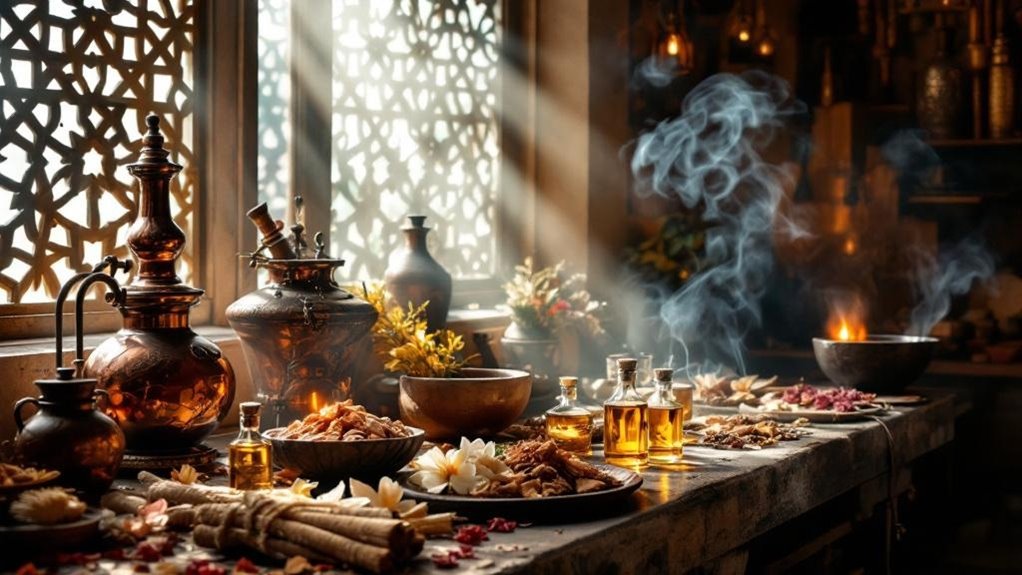
You’ve likely noticed how Arabian perfumes linger on your skin for hours, their complexity deepening with time—a stark contrast to synthetic fragrances that fade within minutes. This remarkable difference stems directly from extraction techniques perfected over centuries in the Middle East. Steam distillation, enfleurage, and extended maceration don’t just preserve aromatic compounds; they fundamentally transform them. Understanding these traditional methods reveals why authentic Arabian perfumes command premium prices and deliver experiences modern chemistry struggles to replicate.
- What Makes Arabian Perfume Different From Western Fragrances?
- Why Arabian Perfumes Use Only Natural Ingredients
- How Steam Distillation Captures Arabian Perfume’s Pure Essence
- Cold Enfleurage: Extracting Fragrance Through Ancient Fat-Absorption
- Why Months-Long Maceration Creates Richer Arabian Scents
- Traditional Oud Extraction: Crafting the World’s Most Expensive Ingredient
- How Master Attarwallahs Preserve Centuries-Old Arabian Perfume Techniques
- Why Arabian Perfumes Choose Oil Over Alcohol Bases
- The Blending Secrets Behind Signature Arabian Fragrance Profiles
- What Slow Aging Does to Arabian Perfume Complexity
- Why Handcrafted Arabian Perfumes Cost More Than Mass-Market Scents
- How Traditional Arabian Perfumes Suit Sensitive Skin Better
- Why Ancient Extraction Methods Are More Sustainable Today
- How to Identify Authentic Traditional Arabian Perfumes
- Frequently Asked Questions
- Conclusion
What Makes Arabian Perfume Different From Western Fragrances?
Arabian perfumes distinguish themselves from Western fragrances through their oil-based compositions rather than alcohol-based formulations.
You’ll notice these attars contain concentrated essential oils that adhere directly to your skin, creating intensely rich, long-lasting sillage. The cultural significance runs deep—Arabian perfumery evolved from ancient trade routes where frankincense, oud, and amber formed precious commodities.
Unlike Western linear scent progressions, you’ll experience complex, multilayered compositions that evolve dramatically over hours. The scent symbolism carries profound meaning: oud represents spirituality, rose embodies purity, and musk signifies sensuality.
These fragrances employ traditional distillation methods dating back millennia, preserving authentic aromatic profiles. You’re encountering bold, resinous, and woody base notes that reflect desert landscapes and Islamic artistic traditions, contrasting sharply with Western floral-fresh preferences.
Why Arabian Perfumes Use Only Natural Ingredients
You’ll discover that Arabian perfumers have relied exclusively on natural essences like oud, rose, and amber for over 5,000 years, believing synthetic compounds can’t replicate the molecular complexity that creates authentic olfactory depth.
These botanical and animal-derived ingredients produce concentrated oils with superior fixative properties—allowing the fragrance to cling to skin and fabric for 12-24 hours compared to alcohol-based synthetics’ 4-6 hour lifespan.
Traditional methods such as hydro-distillation, enfleurage, and cold-pressing preserve the raw materials’ volatile compounds, yielding scent profiles with rich top, heart, and base notes that evolve distinctly throughout the wearing experience.
Purity of Scent Profile
Unlike synthetic fragrances that rely on laboratory-manufactured aroma chemicals, traditional Arabian perfumery has maintained an unwavering commitment to natural ingredients for over three millennia.
This dedication guarantees exceptional scent purity and fragrance authenticity that synthetic compositions can’t replicate.
When you experience authentic Arabian perfumes, you’ll notice several distinctive characteristics:
- Molecular complexity: Natural essences contain hundreds of aromatic compounds that create multifaceted olfactory profiles, while synthetics typically feature 10-15 isolated molecules.
- Temporal evolution: Pure ingredients reveal different notes as they interact with your skin’s chemistry throughout wear.
- Olfactory depth: Undiluted natural extracts provide rich, nuanced layers that synthetic alternatives lack.
Traditional extraction methods—enfleurage, distillation, and cold-pressing—preserve these natural compounds’ integrity, delivering fragrances with unparalleled complexity and genuineness.
Longevity and Sillage Benefits
Because natural aromatics possess substantially higher molecular weights than their synthetic counterparts, authentic Arabian perfumes demonstrate remarkable longevity—often lasting 12-24 hours compared to synthetic fragrances’ typical 4-6 hour wear time.
These longevity factors stem from oil-based formulations that create molecular bonds with your skin’s lipids, releasing scent gradually through body heat.
Sillage definition refers to the aromatic trail you’ll leave behind—literally “wake” in French. Natural oudh, amber, and musk molecules dispersed in sandalwood or jojoba bases project fragrance within a 3-6 foot radius, whereas alcohol-based synthetics evaporate rapidly, diminishing both projection and duration.
Traditional distillation concentrates these heavy molecules at ratios impossible to replicate synthetically, ensuring you’ll experience evolving scent notes throughout wear rather than linear, flat progressions characteristic of laboratory-created alternatives.
Traditional Extraction Techniques
Arabian perfumers have preserved extraction methodologies unchanged since the 8th century, when Jabir ibn Hayyan first documented steam distillation techniques in his alchemical texts.
You’ll find these traditional methods yield superior aromatic compounds compared to modern synthetic processes.
The extraction techniques employ:
- Enfleurage: Cold fat absorption captures delicate jasmine and tuberose molecules without thermal degradation.
- Hydrodistillation: Steam extracts volatile oils from oud wood, preserving complex terpene structures.
- Expression: Manual pressing of citrus peels releases fresh, unoxidized essential oils.
These labor-intensive processes require expertise passed through generations.
You’re experiencing perfumes where extraction techniques determine molecular integrity. The traditional methods maintain biochemical authenticity that mass-production can’t replicate, ensuring you receive nature’s complete aromatic profile rather than isolated fragrance molecules.
How Steam Distillation Captures Arabian Perfume’s Pure Essence
When water transforms into pressurized steam and passes through raw botanical materials, it releases volatile aromatic compounds that have defined Arabian perfumery since the 10th century—a technique Persian polymath Avicenna perfected while distilling rose petals in ancient Persia.
You’ll find this method preserves the molecular integrity of essential oils better than chemical extraction. The steam’s controlled temperature—typically 100°C—prevents thermal degradation of delicate oud, frankincense, and myrrh compounds.
As vapor rises through your distillation chamber, it carries microscopic oil droplets that separate upon cooling, creating two distinct layers. The resulting essential oils retain their complex olfactory profiles: woody base notes, resinous heart accords, and subtle green top notes.
This purity distinguishes authentic Arabian perfumes from synthetic alternatives, delivering concentrated aromatic compounds you can’t replicate through modern shortcuts.
Cold Enfleurage: Extracting Fragrance Through Ancient Fat-Absorption
The enfleurage process relies on purified animal fats—typically beef tallow or pork lard—to absorb volatile aromatic molecules from delicate flower petals that can’t withstand steam distillation’s heat.
You’ll find cold enfleurage particularly suited for Arabian jasmine, tuberose, and rose varieties, where petals rest on glass frames coated with fat absorption layers. Over 24-72 hours, lipophilic compounds transfer into the fat matrix.
The technique’s key advantages include:
- Temperature preservation: Cold enfleurage operates at ambient conditions, maintaining molecular integrity
- Selective extraction: Fat absorption captures only oil-soluble aromatics, filtering unwanted water-soluble elements
- Concentrated yield: Resulting pomades contain 2-3% pure essence by weight
After saturation, you’ll wash the pomade with alcohol to separate the precious absolute—an intensely fragrant concentrate prized in traditional Arabian perfumery.
Why Months-Long Maceration Creates Richer Arabian Scents
When you allow Arabian perfume components to macerate for months, you’re enabling ester formation and chemical equilibration that transforms raw materials into harmonious compositions.
This extended steeping period—traditionally ranging from three to twelve months—permits alcohol molecules to fully penetrate resinous amber, woody oud, and thick floral absolutes, creating stable molecular bonds impossible to achieve through quick mixing.
The result you’ll experience is a scent with remarkable tenacity and depth, where top notes meld seamlessly into heart and base accords rather than evaporating in distinct, disconnected stages.
Molecular Bonding Over Time
As aromatic molecules interact within maceration vessels, they undergo progressive chemical transformations that fundamentally alter a perfume’s olfactory architecture.
During extended aging periods, you’ll witness molecular interactions between essential oils and carrier substances that create entirely new aromatic compounds. This scent evolution mirrors centuries-old Bedouin practices, where merchants stored attars for lunar cycles.
The bonding process yields distinct advantages:
- Ester formation occurs when organic acids react with alcohols, producing smooth, fruity undertones that didn’t exist initially.
- Polymerization links smaller fragrance molecules into complex chains, enhancing longevity and sillage.
- Oxidative maturation softens harsh top notes while deepening base accords, creating the signature warmth Arabian perfumes exhibit.
You can’t rush these chemical reactions—they require patience that modern synthetic fragrances bypass entirely.
Enhanced Fragrance Oil Complexity
Beyond simple molecular bonding, extended maceration periods release multi-dimensional fragrance profiles that distinguish premium Arabian attars from conventional perfumery.
You’ll discover that months-long aging allows volatile compounds to hydrolyze gradually, creating unexpected aromatic molecules absent in fresh distillates. Historical manuscripts from 12th-century Damascus document this transformation, noting how sandalwood base notes develop honeyed undertones after six months’ rest.
The process enables sophisticated scent layering—top notes of rose mellowing into heart notes of amber, while base notes acquire velvety depth.
Your nose perceives this complexity as oil blends mature: sharp citrus edges soften, woody elements develop creamy facets, and floral components reveal spicy nuances.
Master perfumers traditionally assessed readiness through olfactory examination, recognizing when disparate ingredients achieved harmonious integration impossible through mechanical mixing alone.
Traditional Oud Extraction: Crafting the World’s Most Expensive Ingredient
Although oud commands prices exceeding $100,000 per kilogram in today’s luxury fragrance market, its creation begins with a parasitic infection deep within the heartwood of Aquilaria trees.
When fungi penetrate the wood, the tree defends itself by secreting dense, resinous compounds—this is oud resin.
Traditional extraction preserves oud’s complexity through meticulous processes:
- Wood Selection: Artisans identify infected heartwood by its darkened, resin-saturated appearance and weight.
- Hydrodistillation: Aromatic distillation occurs over days in copper stills, using precise temperature control.
- Aging: Distilled oil matures for months, developing its characteristic smoky, leathery, and animalic notes.
You’ll find that master distillers adjust heat and timing based on resin density, wood age, and geographic origin.
This centuries-old methodology yields superior depth compared to modern solvent extraction.
How Master Attarwallahs Preserve Centuries-Old Arabian Perfume Techniques
While modern perfumery relies on synthetic molecules and industrial equipment, master attarwallahs in Arabia’s souks continue blending fragrances using techniques transmitted through generations of oral tradition.
You’ll find these artisans practicing attar craftsmanship in cramped workshops, where apprenticeships span decades before mastery is achieved. They’re employing copper degs (traditional stills) heated over sandalwood fires, extracting essences through hydrodistillation at precisely controlled temperatures.
Heritage preservation depends on memorizing hundreds of formulations without written recipes—each blend’s proportions measured by feel and adjusted according to raw materials’ seasonal variations.
These masters assess quality through olfactory evaluation alone, detecting subtle notes that gas chromatography can’t replicate. Their knowledge encompasses ingredient sourcing, aging processes in leather bottles, and understanding how Middle Eastern humidity affects scent development throughout wearing.
Why Arabian Perfumes Choose Oil Over Alcohol Bases
Among the traditional techniques these master attarwallahs guard most carefully, their preference for oil-based carriers over alcohol represents both practical chemistry and cultural philosophy.
You’ll find that oil bases preserve the delicate molecular structures of rare ingredients like oudh and rose absolute, preventing the harsh evaporation that alcohol causes.
The technical advantages align with fragrance preferences:
- Molecular stability: Oil bases maintain volatile compounds at ambient temperatures, ensuring scent integrity
- Skin affinity: Lipophilic carriers bond with your skin’s natural oils, creating intimate sillage
- Longevity: Slow evaporation rates extend wear time from hours to days
These carriers also respect Islamic traditions prohibiting alcohol consumption, making perfume application a spiritually permissible act of adornment.
The Blending Secrets Behind Signature Arabian Fragrance Profiles
You’ll discover that Arabian perfumers construct their legendary attars through methodical layering of oud, rose absolute, and amber—building complexity by adding ingredients in precise sequences that allow heavier base notes to anchor lighter florals.
Traditional maceration extends from forty days to several months, a timing inherited from medieval Islamic alchemists who understood that patience allows molecular bonds to stabilize and round sharp edges into seamless olfactory harmonies.
Master perfumers rely on trained intuition developed over decades, adjusting ratios by fractions of drops while reading how sandalwood’s creamy warmth interacts with frankincense’s resinous brightness in ways no formula can capture.
Layering Precious Raw Ingredients
Because Arabian perfumers have mastered the art of sequential layering over centuries, their signature scent profiles achieve a complexity that single-note fragrances can’t replicate.
You’ll find these layering techniques follow precise protocols, building from rich base notes to volatile top accords.
Traditional ingredient combinations unfold in three distinct phases:
- Foundation layer: Oudh, amber, and musk anchor the composition with woody, animalic depth
- Heart layer: Rose absolute, saffron, and jasmine sambac create floral richness at 30-minute intervals
- Crown layer: Cardamom, bergamot, and frankincense provide bright, resinous opening notes
You’re experiencing deliberate maceration periods between each layer—sometimes spanning weeks—allowing molecular bonding that produces seamless olfactory changes.
This methodical stratification transforms raw materials into harmonious, long-lasting formulations that evolve distinctly on your skin.
Traditional Maceration Timing Techniques
When master perfumers in the Arabian Peninsula developed their maceration protocols during the Abbasid Caliphate, they discovered that temporal precision directly influenced a fragrance’s molecular stability and olfactory projection. You’ll find that maceration duration varies considerably based on raw material density and desired aromatic intensity.
| Ingredient Type | Ideal Maceration Duration |
|---|---|
| Oud wood chips | 6-12 months |
| Rose absolutes | 3-6 weeks |
| Amber resins | 4-8 months |
| Musk compounds | 2-4 months |
| Sandalwood oils | 8-16 weeks |
Traditional attar-makers monitor temperature fluctuations and molecular integration through sensory evaluation. This scent enhancement methodology guarantees volatiles bond completely with carrier oils, producing complex, long-lasting sillage. You’re experiencing centuries-refined chemistry when Arabian perfumes reveal their characteristic depth and tenacity.
Master Perfumer Intuition Methods
How do master perfumers distinguish between adequate and exceptional fragrance compositions without modern analytical instruments?
Through centuries-refined intuition craftsmanship, these artisans decode olfactory complexity using sensory memory and ancestral knowledge. Master perfumer inspiration emerges from:
- Temporal evaluation protocols – Evaluating fragrance evolution across multiple days, noting how top notes dissipate and base accords strengthen.
- Organoleptic benchmarking – Comparing new blends against historical reference standards stored in their olfactory library.
- Tactile assessment techniques – Evaluating oil viscosity and texture to predict longevity and sillage characteristics.
These perfumers employ what medieval Arab alchemists called “al-hiss al-murakkab” (the compound sense), integrating smell, touch, and visual observation.
They’ll detect imbalances at concentrations below one percent, adjusting ratios through practiced hand movements rather than precise measurements—a methodology preserving traditional authenticity.
What Slow Aging Does to Arabian Perfume Complexity
As Arabian perfumes mature within sealed vessels, their molecular structures undergo deliberate transformation through oxidation and esterification—processes that intensify the interplay between base notes of oud, amber, and musk.
You’ll notice how this complexity evolution distinguishes traditionally-aged attars from modern compositions. Historical Bedouin perfumers understood that patience yields aroma richness: volatile top notes mellow while heavier molecules polymerize, creating seamless changes between scent layers.
Time-honored aging methods create aromatic depth that modern perfumery cannot replicate through synthetic acceleration or chemical shortcuts.
When you experience properly aged Arabian perfume, you’re detecting compounds that didn’t exist at formulation. The sharp medicinal qualities of fresh oud soften into honeyed leather, while amber develops caramelized depth.
This maturation—sometimes spanning years—produces olfactory profiles impossible to synthesize. You’re experiencing chemistry guided by time-honored empirical knowledge, where controlled environmental conditions allow natural molecular reorganization.
Why Handcrafted Arabian Perfumes Cost More Than Mass-Market Scents
Because traditional Arabian perfumery demands rare raw materials and labor-intensive extraction methods, you’ll find price differentials of 300-500% compared to synthetic alternatives.
The handcrafted artistry behind authentic ouds and attars requires master perfumers who’ve trained for decades, commanding premium compensation for their expertise.
Several factors justify these elevated price points:
- Raw material scarcity: Wild agarwood trees yield precious resin only after fungal infection, requiring 15-30 years of maturation.
- Traditional distillation: Hydro-distillation processes span 10-15 days per batch versus industrial synthesis completed in hours.
- Luxury branding authenticity: Heritage houses maintain centuries-old formulations, preserving regional fragrance identities.
You’re investing in olfactory complexity that mass-production can’t replicate—each bottle represents months of maceration, historical knowledge transmission, and sensory refinement that machines can’t duplicate.
How Traditional Arabian Perfumes Suit Sensitive Skin Better
Unlike synthetic fragrances that rely on petroleum-derived compounds and phthalate fixatives, traditional Arabian perfumes employ botanical extracts and animal-derived essences that minimize dermatological reactions. You’ll find these sensitive formulations particularly beneficial if you experience irritation from commercial scents.
The superior skin compatibility stems from centuries-old distillation techniques that preserve natural molecular structures. Artisans extract essences through steam distillation and cold-pressing, avoiding harsh chemical solvents that compromise dermal tolerance.
| Component Type | Traditional Arabian | Synthetic Modern |
|---|---|---|
| Base Materials | Rose absolute, oud resin | Diethyl phthalate, synthetic musks |
| Extraction Method | Steam distillation, enfleurage | Chemical synthesis, petrochemical processing |
| pH Balance | Naturally skin-neutral | Requires artificial adjustment |
You’re applying formulations that historically adorned royalty without causing inflammation or sensitization.
Why Ancient Extraction Methods Are More Sustainable Today
You’ll find that ancient Arabian extraction methods—steam distillation, cold enfeuilage, and expression—require minimal energy input and produce zero synthetic waste, unlike petroleum-derived modern processes.
These time-honored techniques preserve the complete aromatic profile of jasmine, oud, and rose while maintaining a negligible carbon footprint through their reliance on renewable fuel sources and biodegradable materials.
Today’s shift toward sustainable luxury has revealed what Bedouin perfumers understood centuries ago: slow extraction at low temperatures yields superior olfactory complexity without environmental degradation.
Low Environmental Impact Methods
When distillers in ninth-century Damascus refined their copper alembics to capture rose essence, they unknowingly established protocols that modern sustainability experts now champion. These eco friendly techniques consume minimal energy—sunlight dries petals, gravity feeds condensers, and wood-fired stills require no electricity.
You’ll find sustainable sourcing embedded in traditional Arabian perfumery through:
- Solar distillation systems that harness desert heat for hydrosol extraction
- Zero-waste processing where spent botanicals become compost for future harvests
- Local wild-harvesting that eliminates transportation emissions and preserves indigenous flora
Traditional enfleurage demands patience rather than petrochemicals. Cold-pressing techniques extract precious oud without chemical solvents.
Steam distillation’s closed-loop system recycles water indefinitely. These time-honored methods aren’t merely romantic relics—they’re blueprints for contemporary perfumers seeking environmental responsibility.
Traditional Versus Modern Sustainability
While industrial perfumery‘s synthetic musks and petroleum-derived fixatives dominate today’s $50 billion fragrance market, they’ve created cascading environmental costs that ancient Arabian methods never imposed.
Traditional sustainability manifests through attars’ biodegradable sandalwood bases, zero-waste hydrodistillation, and carbon-neutral production cycles. You’ll find modern techniques require petrochemical solvents, energy-intensive synthesis, and non-degradable packaging—generating persistent pollutants absent in classical extraction.
Arabian distillation’s copper alembics, wood-fired heat sources, and botanical ingredients decompose naturally within seasons.
Modern spray fixatives contain phthalates persisting decades in waterways. The traditional approach cycles entirely within nature’s metabolism: rose petals return to soil, sandalwood oil evaporates cleanly, and copper vessels last generations.
Contemporary fragrance production leaves permanent molecular signatures in ecosystems, validating why pre-industrial methods now represent genuinely sustainable luxury.
How to Identify Authentic Traditional Arabian Perfumes
Because authentic Arabian perfumes possess distinctive characteristics rooted in centuries-old distillation methods, you’ll need to examine several key indicators to separate genuine attars and mukhallats from synthetic imitations. Traditional compositions exhibit oil-based viscosity rather than alcohol dilution, leaving subtle residue when rubbed between fingers.
Authentic Arabian perfumes reveal their heritage through oil-based viscosity and traditional distillation methods that synthetic versions cannot replicate.
Authenticity markers include hand-blown crystal bottles with precise stopper seals and Arabic calligraphy denoting origin.
Conduct thorough scent testing by evaluating:
- Initial projection: Natural attars bloom gradually, releasing complex top notes of oud, rose, or amber over 15-30 minutes
- Longevity: Genuine oil-based formulations persist 8-12 hours, evolving through distinct phases
- Base complexity: Artisanal blends reveal layered resins, woods, and musks absent in synthetic reproductions
Historical distillation techniques produce characteristic depth that modern chemistry can’t replicate accurately.
Frequently Asked Questions
What Is the Typical Shelf Life of Traditional Arabian Perfumes?
You’ll find traditional Arabian perfumes maintain exceptional shelf life of 3-5 years when properly stored. Their concentrated oil-based compositions guarantee remarkable fragrance longevity, with rich amber and oud notes developing deeper, more complex olfactory profiles over time.
Can Traditional Arabian Perfumes Be Worn in Hot Climates Effectively?
You’ll hit the jackpot with traditional Arabian perfumes in hot climates—their oil-based compositions guarantee exceptional fragrance longevity and scent intensity. Heat actually amplifies their rich, resinous notes, making them perfectly suited for warm environments.
How Should Traditional Arabian Perfume Oils Be Properly Stored at Home?
You’ll preserve fragrance longevity by storing your oils in cool, dark spaces using traditional storage techniques—amber glass vessels shield precious essences from light degradation, while maintaining temperatures between 15-20°C prevents molecular deterioration of volatile compounds.
Are Traditional Arabian Perfumes Suitable for Daily Workplace Wear?
You’ll find traditional Arabian perfumes’ workplace appropriateness depends on concentration and composition. Oil-based attars offer subtle, skin-close daily fragrance suitable for professional settings, while intense mukhallats may overwhelm colleagues in confined spaces.
What Price Range Should Buyers Expect for Authentic Arabian Perfumes?
You’ll find authentic Arabian perfumes ranging from $50-$500+ per ounce. Price guides reveal quality’s correlation with concentration levels, while authenticity assessment demands examining ingredient provenance—real oud and amber justify premium costs through traditional distillation methods.
Conclusion
You’ll find that traditional Arabian perfumery techniques—refined since before anyone could Google “best fragrance”—deliver unmatched olfactory complexity through precise molecular preservation. When you’re selecting authentic attar, you’re investing in hydrodistillation’s capacity to capture volatile aromatic compounds at ideal temperatures, enfleurage’s fat-solubility principles extracting delicate florals, and maceration’s time-dependent chemical synthesis creating deep, resinous base notes. These centuries-old extraction methodologies don’t just produce perfume; they’re engineering sophisticated scent architectures that synthetic processes can’t replicate, offering your skin naturally compatible, richly layered fragrance experiences.